
UK Visa Sponsor Report 2026: 143,071 Licensed Sponsors
Published Nov 7, 2026
The Home Office register dated 4 Nov 2026 lists 143,071 sponsor licences from 127,359 organisations — by city, route, rating and sector. Free, no paywall.

What does the UK sponsor register actually show in 2026?
The UK Home Office register dated 4 November 2026 lists 143,071 sponsor licence entries from 127,359 organisations. Skilled Worker licences make up 86 percent of all entries, 99.86 percent of entries are A-rated, and London alone holds 43,847 entries, nearly a third of the whole register.
PakkiNaukri is a free job board and CV builder for job seekers in Pakistan and for visa-sponsorship jobs in the UK, USA, Europe, the Gulf, Australia and New Zealand. We publish the full sponsor register free, with no paywall and no sign-in, and this report is what the register itself shows when you count it. Every number below comes from the official Home Office register of licensed sponsors dated 4 November 2026, all 143,071 entries counted in full.
Two words in this report need a plain explanation before you read on. An entry is one licence on one visa route. An organisation is one employer. One employer can hold licences on more than one route, which is why entries, at 143,071, outnumber organisations, at 127,359. When this report says a city holds a number of entries, it means licences tied to employers in that town or city, not job vacancies. A licence only means the employer is allowed to sponsor. It does not mean the employer is hiring now, and it does not mean it will sponsor any particular applicant. That distinction runs through everything that follows, and it is the single most useful thing to understand before you use the register.
What are the five headline facts?
First, the register holds 143,071 licence entries from 127,359 organisations. The gap between the two numbers, 15,712, is employers that hold licences on more than one route. A hospital trust, for example, might hold a Skilled Worker licence and a licence for another route at the same time, and the register counts each one separately. So when you search the register and see the same employer name twice, that is usually one employer with two licences, not a duplicate and not two different companies.
Second, Skilled Worker dominates the register. It holds 123,097 entries, which is 86 percent of everything. The next route, Global Business Mobility: Senior or Specialist Worker, holds 10,404 entries, or 7.3 percent. All other 16 routes together hold 9,570 entries, which is 6.7 percent. In practice this means that for most job seekers, sponsorship means the Skilled Worker route. The other routes matter, but they matter for particular kinds of work, and the routes section below works through each of them in turn.
Third, London holds 43,847 entries, or 30.6 percent of the register. That is more than the other 19 towns in the top 20 put together, which hold 24,387 between them. Birmingham is second with 3,334 entries and Manchester third with 3,097. No other town passes 1,600. London is not just first, it is first by a distance that dwarfs the rest of the country, and the cities section below gives the full top 20 for the first time, with the ten places the first version of this report did not list.
Fourth, almost every entry is A-rated. 142,864 of 143,071 entries carry an A rating, which is 99.86 percent. Only 111 entries carry a B rating, and 96 are provisional UK Expansion Worker licences. The rating matters because a B-rated sponsor cannot take on new sponsored workers from overseas until it improves, so the rating is one of the first things to check about any employer you are considering.
Fifth, care and health is the largest sector you can pick out of the register by name. 13,090 entries, or 9.1 percent, across 12,694 organisations carry a care, health, NHS, hospital, clinic, dental, medical or similar word in their registered name. Read the method note in the sectors section before quoting that figure, because the register has no sector column and the figure comes from matching words in organisation names. Even with that caution, the size of the care and health presence is real, and it shapes where sponsored jobs actually sit.
Which UK cities have the most licensed sponsors?
London is first, and the gap after it is the story of this table. Birmingham, in second place, holds 3,334 entries, which is less than a thirteenth of London's 43,847. Manchester, in third, holds 3,097. The rest of the top 20 sits between 1,505 and 747. Put another way, the top 20 towns and cities together hold 68,234 entries, or 47.7 percent of the whole register, and London alone holds almost two thirds of that top-20 total. If you are looking for sponsored work, London is where the licences are. That does not mean London is where your job is, because a licence is not a vacancy, but it does mean the odds of finding a licensed employer are far higher there than anywhere else.
Here is the full top 20, counted from the register in full, with each town's share of all 143,071 entries:
- 1. London — 43,847 licence entries, 30.6 percent of the register
- 2. Birmingham — 3,334 licence entries, 2.3 percent of the register
- 3. Manchester — 3,097 licence entries, 2.2 percent of the register
- 4. Glasgow — 1,505 licence entries, 1.1 percent of the register
- 5. Leicester — 1,492 licence entries, 1.0 percent of the register
- 6. Bristol — 1,468 licence entries, 1.0 percent of the register
- 7. Edinburgh — 1,316 licence entries, 0.9 percent of the register
- 8. Leeds — 1,187 licence entries, 0.8 percent of the register
- 9. Nottingham — 1,133 licence entries, 0.8 percent of the register
- 10. Reading — 1,085 licence entries, 0.8 percent of the register
- 11. Coventry — 987 licence entries, 0.7 percent of the register
- 12. Cambridge — 980 licence entries, 0.7 percent of the register
- 13. Milton Keynes — 976 licence entries, 0.7 percent of the register
- 14. Ilford — 953 licence entries, 0.7 percent of the register
- 15. Slough — 937 licence entries, 0.7 percent of the register
- 16. Harrow — 843 licence entries, 0.6 percent of the register
- 17. Liverpool — 813 licence entries, 0.6 percent of the register
- 18. Bradford — 781 licence entries, 0.5 percent of the register
- 19. Sheffield — 753 licence entries, 0.5 percent of the register
- 20. Luton — 747 licence entries, 0.5 percent of the register
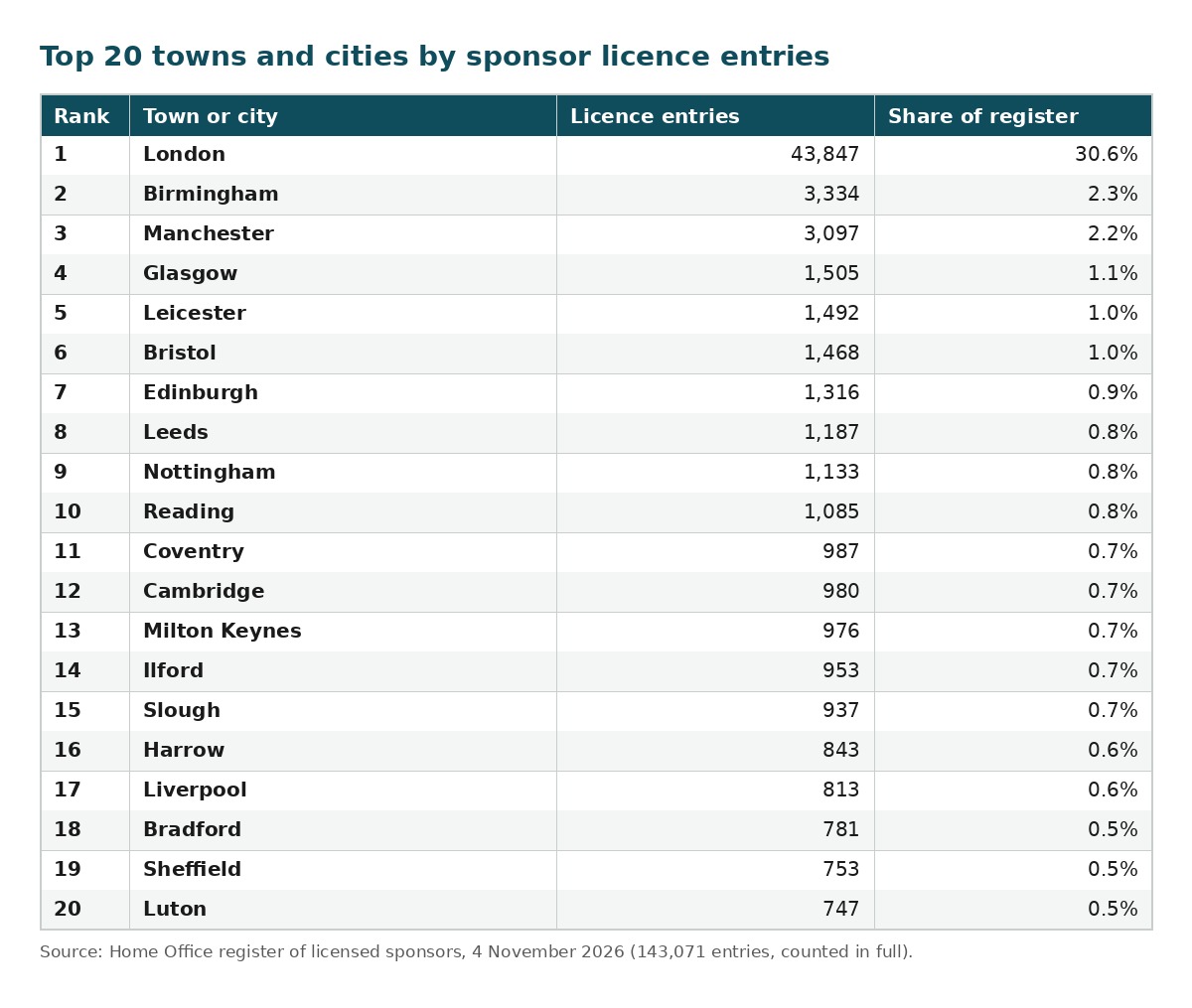
Top 20 towns and cities by sponsor licence entries, Home Office register dated 4 November 2026.
A few things in this table are worth noticing. Glasgow, in fourth place, is the only Scottish city in the top 10, and Edinburgh, in seventh, is the other Scottish city in the top 20. Together they hold 2,821 entries, which is less than Birmingham alone. Leicester, in fifth, holds more licences than Bristol, Edinburgh, Leeds or Nottingham, which surprises people who think of it as a smaller city. It is a reminder that the register follows employers, not population or reputation.
The second half of the table, places 10 to 20, is where the working geography of sponsorship sits. Reading, Coventry, Cambridge and Milton Keynes are all commuter and business towns with large employer bases. Ilford, Slough and Harrow sit in or near London's orbit, and part of their count is London's economy spilling over its boundary. Liverpool, Bradford, Sheffield and Luton are large towns and cities in their own right, each holding between 747 and 813 entries. None of them is a small number in absolute terms. A town with 747 licensed sponsors still holds 747 employers that are allowed to sponsor, and for a job seeker willing to look beyond London, these are the places where the search is most likely to pay off.
There is also a practical point about how the register records place. Towns are counted exactly as the Home Office register spells them, ignoring capital letters, so London and LONDON count as one place. One entry in the register has no town recorded at all, which is why the counts in this report add up the way they do. If you search the free sponsor list by town and find nothing, try the county or the nearest large town, because some employers are registered under a neighbouring place name.
The register itself is published by the Home Office on GOV.UK, and the free searchable copy on PakkiNaukri republishes the Home Office's own data unchanged. For the full list, search the UK Sponsor Licence List, where all 143,071 entries are searchable by organisation name, town or city, and visa route. If you want the wider picture of sponsored work rather than the register alone, our guide to sponsorship jobs in the UK explains the sponsored route in plain terms, and our page on companies providing sponsorship in the UK looks at the employers behind the licences.
Which visa route holds the most sponsor licences?
Skilled Worker holds 123,097 entries, or 86 percent of the register. The next route, Global Business Mobility: Senior or Specialist Worker, holds 10,404 entries, or 7.3 percent. Between them, the two routes hold 133,501 entries, which is 93.3 percent of the whole register. Everything else is small by comparison, and that is the first thing a job seeker should take from this section. If you are looking for a sponsored job, you are almost certainly looking for a Skilled Worker sponsor, and the register is mostly a list of Skilled Worker licences.
Skilled Worker is the main route for sponsored jobs in the UK. It covers the ordinary case: a UK employer offers a job to a worker from overseas, and the employer holds a licence that lets it sponsor that worker. Most of the employers on the register hold this licence, and most of the jobs a job seeker will ever apply for sit under it. When a guide or an employer talks about sponsorship without naming a route, it almost always means Skilled Worker. If you only learn one route from this report, learn this one.
Global Business Mobility: Senior or Specialist Worker is a different kind of route. It covers multinational companies moving their own senior or specialist staff to the UK, rather than hiring someone new from outside. The worker is already employed by the company overseas and comes to the UK to work for the same company. That is why it holds 10,404 entries while producing very few open vacancies. A job seeker applying from outside cannot simply apply for these roles the way they would apply for a Skilled Worker job, because the route is built for internal transfers, not open recruitment. Knowing this saves wasted applications.
The other 16 routes together hold 9,570 entries, or 6.7 percent of the register. Here they are, all of them, in order:
- Tier 2 Ministers of Religion — 1,959 entries, 1.4 percent. This route covers people coming to the UK for a role within a faith community, such as a minister of religion. It is a Worker route, and it sits in the register because faith organisations hold sponsor licences for it.
- Creative Worker — 1,576 entries, 1.1 percent. This is a Temporary Worker route for people working in the creative industries, such as performers, artists and production staff, usually for a short engagement rather than a permanent job.
- Charity Worker — 1,525 entries, 1.1 percent. This is a Temporary Worker route for unpaid voluntary work for a charity. The key word is unpaid. It is not a route into paid employment, and anyone offered a paid job under this name should check the details carefully.
- International Sportsperson — 1,468 entries, 1.0 percent. This route covers elite sportspeople and coaches who are internationally established at the highest level. The numbers are small because the bar is high, and the register entries belong mostly to clubs and sporting bodies.
- Religious Worker — 1,433 entries, 1.0 percent. This is a Temporary Worker route for religious work such as preaching or pastoral work, distinct from the Minister of Religion route above. The two routes look similar, and the difference between them is the kind of role and the length of stay, so an applicant should check which one an employer actually holds.
- Global Business Mobility: Graduate Trainee — 623 entries, 0.4 percent. This route covers trainees who are on a structured graduate training programme with a multinational company and are sent to the UK as part of it. Like the Senior or Specialist route, it is for people already inside a company, not for open applications.
- Global Business Mobility: UK Expansion Worker — 437 entries, 0.3 percent. This route covers workers sent to the UK to set up a branch or subsidiary of an overseas business. The 96 provisional licences in the register belong to this route, because a UK Expansion Worker licence starts as provisional. It is a route for companies expanding into the UK, not for job seekers looking for an open vacancy.
- Government Authorised Exchange — 248 entries, 0.2 percent. This is a Temporary Worker route for people coming to the UK on an approved exchange scheme, such as a work experience or training scheme run by an approved organisation.
- International Agreement — 134 entries, 0.1 percent. This route covers work done under international law, such as employees of overseas governments or international organisations, and people providing services covered by an international agreement.
- Scale-up — 93 entries, 0.1 percent. This route is for fast-growing UK companies, known as scale-up businesses, to sponsor workers. The number is small, 93 entries, which tells you how narrow the route is in practice. Our separate page on scale-up visa companies looks at the employers behind these licences, and it is worth reading if you work in a field where fast-growing companies hire.
- Global Business Mobility: Service Supplier — 55 entries, under 0.1 percent. This route covers workers who come to the UK to provide a service under a contract, employed by an overseas service provider.
- Seasonal Worker — 6 entries. This route covers seasonal work, and the register holds only 6 entries for it, because seasonal work is licensed through a small number of scheme operators rather than through individual employers.
- Global Business Mobility: Secondment Worker — 6 entries. This route covers workers seconded to the UK under a high-value contract or investment.
- Tier 2 General — 5 entries. This is a legacy route name. The Skilled Worker route replaced Tier 2 General, and the 5 entries that remain are old licences still sitting on the register.
- Intra-company Routes — 1 entry. Another legacy name, left over from before the current route names came in.
- Intra Company Transfers (ICT) — 1 entry. Also a legacy name, from the old intra-company transfer route that the Senior or Specialist Worker route replaced.
Three lessons follow from this list. First, the register is a Skilled Worker register with a long tail. Anything that is not Skilled Worker or Senior or Specialist Worker is a niche, and a job seeker should not build a plan around a niche route without first checking that the route can actually lead to the job they want. Second, several routes are for people already employed by a multinational company, and they produce almost no open vacancies, so a high entry count on those routes does not mean a high number of jobs. Third, the legacy entries are a reminder that the register carries history. A route name with one or five entries is not a live opportunity, it is a leftover.
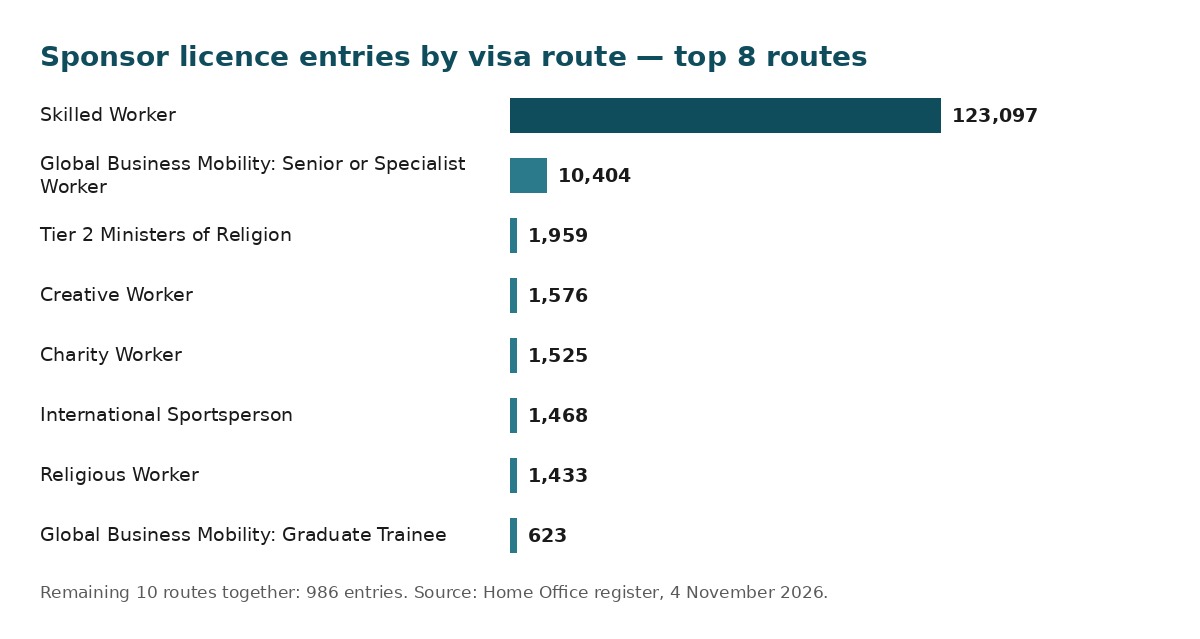
Sponsor licence entries by visa route, top 8 routes, Home Office register dated 4 November 2026.
What does a sponsor's rating mean for you?
A rating is the Home Office's judgement of whether a sponsor is meeting its sponsorship duties. It is one of the first things to check about any employer, because it decides whether the employer can actually sponsor you right now.
An A rating is the standard full rating. 142,864 entries carry an A rating, which is 99.86 percent of the register. That total includes the ordinary A rating and the small number of A (Premium) and A (SME+) ratings, which are A ratings held by sponsors who pay for extra Home Office support services. For a job seeker they count the same as any other A rating. The practical meaning is simple: an A-rated sponsor is in good standing, and it can sponsor workers.
A B rating means the sponsor is on an action plan. 111 entries carry a B rating. The Home Office puts a sponsor on an action plan when it finds compliance problems, and while the sponsor is B-rated it cannot take on new sponsored workers from overseas until it earns its A rating back. That is the single most important fact in this section. A B-rated employer may still appear in job adverts, and it may still be a real company with real jobs, but it cannot sponsor a new worker from overseas while the B rating stands. If you are applying from outside the UK, a B rating is a stop sign, not a detail.
A provisional rating means the licence is provisional. 96 entries are provisional UK Expansion Worker licences. A UK Expansion Worker licence starts as provisional because the UK branch it belongs to is still being set up, and the sponsor has to meet further conditions before the licence becomes a full A rating. Provisional licences belong to companies expanding into the UK, so they rarely connect to an open vacancy a job seeker can apply for.
How should you use the rating in practice? Check it before you apply, not after. Search the employer on the free sponsor list, open its entry, and look at the rating and the route together. The entry must cover the visa you want, which for most people is Skilled Worker, and it must be A-rated. If the rating is B, move on and spend your time on an A-rated employer instead. If the rating is provisional, understand that the licence is tied to a company setting up in the UK, and the job you want may not exist yet. If the employer does not appear on the register at all, it cannot sponsor you, whatever its advert says. That check takes a minute, and it is the cheapest way to avoid a wasted application.
One more caution belongs here. Ratings change. The Home Office updates the register on most working days, and licences are suspended and revoked between updates. A rating that was A when this report was counted may not be A when you read it. Always confirm an employer's current status on GOV.UK before relying on it for a decision that matters, such as accepting a job offer or paying for a visa application.
Which sectors hold the most sponsor licences?
Care and health is the largest sector you can pick out of the register by name. 13,090 entries, or 9.1 percent of the register, across 12,694 organisations carry a care, health, NHS, hospital, clinic, dental, medical or similar word in their registered name. That is roughly one entry in every eleven. It is the biggest identifiable group in the register, and it is why so much sponsorship advice is aimed at care workers, nurses and health staff.
Read the method note before quoting that figure. The register has no sector column. It lists organisation names, towns, ratings and routes, but it does not say what business an employer is in. The care and health figure comes from matching words in registered names, and it is an approximation, not an official count. An employer with the word care in its name is almost certainly a care provider, but a hospital trust with a place name in its title will not be caught, and a company with the word health in its name might sell health products rather than provide care. The figure is useful as a sense of scale, and it should not be quoted as though the Home Office published it.
Even with that caution, the pattern is clear. Care homes, home care agencies, NHS trusts, clinics, dental practices and medical staffing firms hold thousands of sponsor licences between them. That is why our guide to care homes with visa sponsorship exists, and why it starts with an employer-verification method rather than a list of names. In care, the employer matters more than the vacancy, because the same job title can sit with a licensed employer or an unlicensed one, and only the licensed one can sponsor.
There is one more thing to know about care, and it is recent. Since 22 July 2025, overseas recruitment for care workers has been closed, so a care employer on the register is not automatically hiring from overseas now. The licence is still there, and the employer may still hold it, but the route that used to bring care workers in from overseas no longer works the way it did. If you work in care and you are applying from outside the UK, check the employer's current hiring position and the current rules before you assume a licence means an open door. The register shows who holds a licence. It does not show who is hiring, and in care that gap is wider now than it was a year ago.
What about the rest of the register? The register does not break down into sectors, so no other sector figure can be counted the same way. What can be said is that the register covers every kind of employer, from universities and manufacturers to hotels, restaurants, builders and recruitment firms, and the city and route tables above are the honest way to read it. If a sector guide promises an exact count of sponsors in its sector, ask how it counted, because the register does not hand out sector totals.
How do you check one employer on the register?
Checking an employer takes a minute, and it is the most useful skill in this whole report. Here is how to do it, step by step, on the free sponsor list.
First, open the UK Sponsor Licence List. It holds all 143,071 entries, and you can search it by organisation name, town or city, and visa route, with no paywall and no sign-in.
Second, type the employer's exact registered name into the search box. Registered name matters, because the register uses the employer's legal name, which is often not the trading name on its website or its job adverts. A care home that advertises as Sunnydale Care may be registered as Sunnydale Care Homes Ltd, and a hotel that trades as The Riverside may be registered under its owning company's name. If your first search finds nothing, try the company name without Ltd or Limited, try a shorter part of the name, and try the town where the job is based. Add the town or the route to narrow the list down when the name alone brings back too many results.
Third, read the entry, not just the name. Check three things. The route must cover the visa you want, which for most people is Skilled Worker. The rating must be A. And the town must match the place where the job actually is, because a large employer can hold licences in more than one town. If all three line up, the employer can sponsor you for that route, subject to the job itself meeting the visa rules.
Fourth, confirm the result on the official register. The Home Office publishes the register on GOV.UK, and our list republishes the Home Office's own data unchanged. For a decision that matters, such as accepting a job offer, check the employer on the Home Office register of licensed sponsors on GOV.UK as well, because the Home Office updates the register on most working days and licences are suspended and revoked between updates.
What should you do if the employer is not on the register? Take the answer seriously. If an employer is not on the register, it cannot sponsor you, whatever its advert says and whatever its recruiter tells you. Do not send money, documents or fees to an employer that is not on the register, and do not accept a promise that sponsorship will be arranged later. If you still want the job, you can ask the employer whether it plans to apply for a licence, but understand that applying for a licence takes time and there is no guarantee it will be granted. The safe move is to spend your effort on employers that already hold a licence. Our guide on how to check a sponsor licence walks through the same check in more detail.
Three traps catch people, and all three come from the way the register is built. The first is similar names. The register holds 127,359 organisations, and many of them share words in their names. Two care homes in the same town can have nearly identical names, and a recruitment agency can share a name with an unrelated company in another city. Always match the town and, if you can, the full registered name, before you conclude that the employer in front of you is the licensed one.
The second trap is multiple licences per organisation. One employer can hold licences on more than one route, and the register carries one entry per route. Seeing the same name twice does not mean there are two employers, and it does not mean the employer is hiring for two jobs. It means the employer holds two licences. Count the employer once, and check the route you actually need.
The third trap is the difference between a licence and a vacancy. A licence only means the employer is allowed to sponsor. It is not a job, it is not a promise of a job, and it does not mean the employer is hiring now. The register tells you who can sponsor. The jobs board tells you who is hiring. Use both, and do not mistake one for the other.
There is one more warning that belongs in this section, because it costs people money. A genuine sponsor never charges you for a Certificate of Sponsorship. Employers must not pass the sponsor licence fee or the Certificate of Sponsorship fee on to the worker. If a company asks you to pay for a Certificate of Sponsorship, treat it as a warning sign. Check the company against the register and GOV.UK before you send anyone money or documents, and if the company is not on the register, walk away.
How should you use this report in your job search?
Start with the route, then the city, then the employer. That order saves the most time. First, settle on the route that fits your work, which for most people is Skilled Worker. Second, pick the places where licensed employers actually are, using the top-20 table above. London holds the most licences by far, but Birmingham, Manchester, Glasgow, Leicester and Bristol each hold more than 1,400, and the second half of the top 20 holds hundreds more each. Third, check the employers in those places on the free sponsor list, and apply only where the route is right and the rating is A.
If you work in care or health, start with the care employers in the register, but remember what the sectors section says about the closure of overseas recruitment for care workers since 22 July 2025, and check the current rules before you apply. If you work in hospitality, read our guide to chef jobs with visa sponsorship in the UK, which explains the tighter rules for chefs in plain terms. If you are open to more than one country, our guide to jobs in Canada with visa sponsorship covers the Canadian side of the same search. And if you are weighing the UK against other options, the sponsorship jobs guide linked at the top of this report puts the UK route in context.
Keep the register date in mind as you use this report. The numbers here come from the register dated 4 November 2026, counted in full on 7 November 2026. The Home Office updates the register on most working days, so the live list will have moved on by the time you read this. Use this report for the shape of the register, which changes slowly, and use the live sponsor list for the employer in front of you, which can change any day.
Frequently asked questions
How many licensed sponsors are there in the UK in 2026?
The Home Office register dated 4 November 2026 lists 143,071 sponsor licence entries from 127,359 organisations. One employer can hold licences on more than one visa route, which is why entries outnumber organisations.
Which UK city has the most licensed sponsors?
London, with 43,847 licence entries, or 30.6 percent of the register, which is more than the other 19 towns in the top 20 put together. Birmingham is second with 3,334 entries and Manchester third with 3,097.
Which visa route has the most sponsor licences?
Skilled Worker, with 123,097 entries, or 86 percent of the register. The next route, Global Business Mobility: Senior or Specialist Worker, holds 10,404 entries, or 7.3 percent.
What does an A-rated sponsor licence mean?
An A rating is the Home Office's standard full rating. 99.86 percent of entries, 142,864 of 143,071, are A-rated. A B rating means the sponsor is on an action plan and cannot sponsor new workers from overseas until it improves, so check the rating before you apply.
How can I check if a UK employer can sponsor my visa?
Search the employer free in the UK Sponsor Licence List on PakkiNaukri. All 143,071 entries are searchable by organisation name, town or city, and visa route, with no paywall and no sign-in. If an employer is not on the register, it cannot sponsor you, so confirm the result on GOV.UK before relying on it.
Put it to work on real, checked jobs.
Every job on PakkiNaukri is taken from a company’s own careers page and re-checked daily, and a free account scores each one against your CV. Start with today’s list.