
Hounslow Teaching Jobs: A Complete Guide
Published Nov 11, 2026
Hounslow teaching jobs: Outer London pay, QTS and supply routes, and how to apply for primary, secondary and SEN posts in the borough.

Hounslow teaching jobs: the honest answer first
Hounslow teaching jobs are primary, secondary and special-school posts in a West London borough, paid on the Outer London scale. A qualified teacher starts at £39,196 a year, supply pays £165–£185 a day, and teaching assistants earn £85–£110 a day, according to live Hounslow listings read on 11 November 2026. January 2027 starts are already advertised.
That is the short version. The longer version is that Hounslow is one of the more practical places in London to build a teaching career, and the reason is not glamour. It is the combination of Outer London pay, a steady flow of vacancies across primary, secondary and special schools, and a January hiring window that most job guides never mention. September gets all the attention, but the listings prove January is a real hiring window: posts starting in January 2027 were already advertised in November 2026.
Hounslow sits in West London, between central London and Heathrow. Its schools serve some of the most diverse classrooms in the country, with many languages spoken at home and families working shifts at the airport, in hospitals, in shops and in offices. If you like classrooms where no two days feel the same, that is a genuine draw, not a line from a recruitment advert.
PakkiNaukri is a free job board and CV builder for job seekers in Pakistan and for visa-sponsorship jobs in the UK, USA, Europe, the Gulf, Australia and New Zealand. This guide is written for anyone weighing a teaching job in this one borough: qualified teachers, people training now, supply teachers, teaching assistants, and overseas teachers checking whether Hounslow is a realistic target. It uses live listing figures from 11 November 2026 and official sources, and it says where the numbers come from. For the wider London picture, our page on sponsors by city in London shows how many licensed sponsors sit in the capital, and our guide to sponsorship jobs in the UK explains the sponsored route in plain terms.
What is a Hounslow teaching job, and who hires here?
A Hounslow teaching job is a teaching or classroom-support post in a school in the London Borough of Hounslow, in West London. The borough boundary matters more than it looks: Hounslow is an Outer London borough, so its teachers are paid on the Outer London scale, not the Inner London scale and not the rest-of-England scale. The figures in this guide are Outer London figures.
The employers are the borough's schools themselves. Hounslow has maintained primary and secondary schools, academies, special schools and special educational needs and disabilities (SEND) provisions, and nursery and early-years settings. The live listings from 11 November 2026 show the range clearly: early-years and Key Stage 1 posts, Key Stage 2 teachers, secondary subject teachers including modern foreign languages, special educational needs (SEN) teachers in mainstream primaries and in specialist provisions, and teaching assistants across primary and secondary. January 2027 starts appear across that range, which tells you the hiring is not a single school filling a single gap. It is the borough's normal rhythm.
Many Hounslow posts are advertised through supply agencies and jobs boards rather than on a school's own site, so a school advert and an agency advert for the same classroom can look like two different jobs. Read both, note the school if it is named, and apply once, through the route that reaches the hiring school. If the school is not named, the agency is acting as the gatekeeper, and your application goes through them. Either way, the check that matters before you invest hope is the employer's identity: who runs the school, and whether it can sponsor you if you need a visa. Our free UK sponsor licence list lets you search any employer by name or town, and our step-by-step guide to checking the sponsor licence list walks through the check itself. For the general method of finding sponsored roles, read our guide to jobs with sponsorship in the UK.
How much do Hounslow teachers actually earn?
Live Hounslow listings read on 11 November 2026 show Key Stage 2 and early-years teacher posts advertised at MPS1 to MPS6, Outer London, at £39,196 to £52,241 a year — the main pay scale, from a newly qualified teacher to an experienced teacher at its top. The Department for Education published the 2026 School teachers' pay and conditions document on 16 October 2026, and the official document is the place to check the scale itself: read it on GOV.UK's school teachers' pay and conditions page, live-verified on 11 November 2026. The listing figures above are what Hounslow schools are actually advertising, and they sit on that official scale.
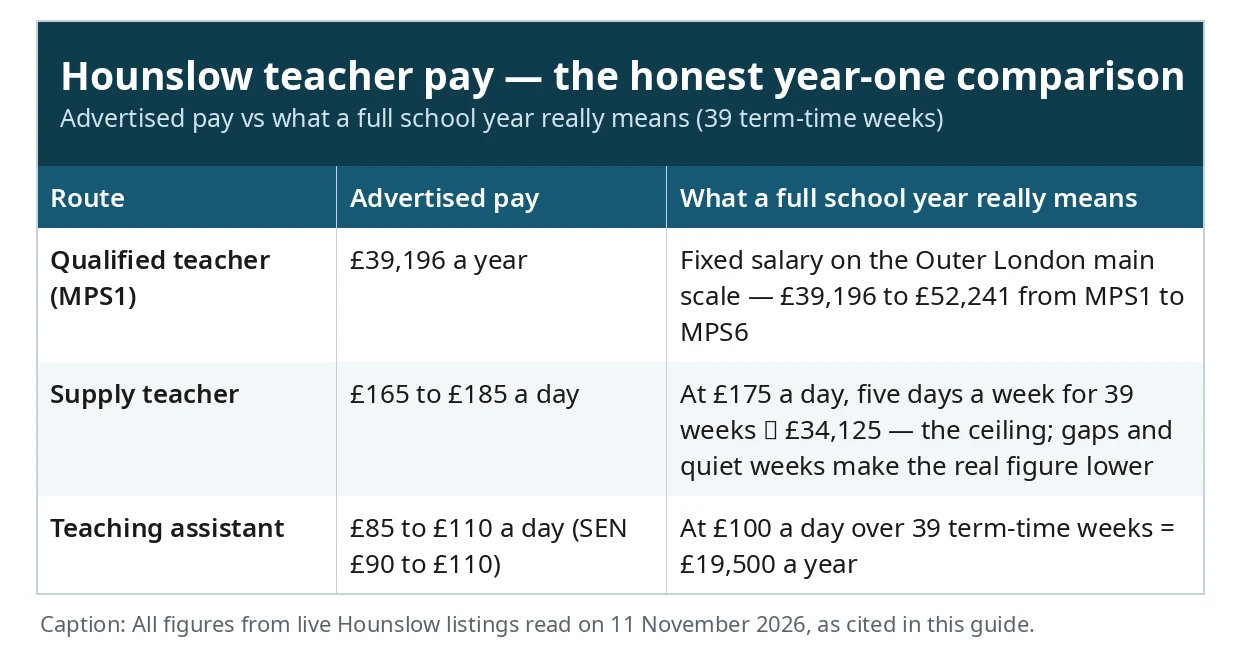
Supply teaching pays by the day. Live Hounslow listings on 11 November 2026 show primary supply at £165 to £185 a day, with secondary and cover work in the same band. Teaching assistants earn less: £85 to £110 a day in live listings, and SEN teaching assistants £90 to £110 a day. Those are daily rates, and the comparison with a salary only works if you turn them into a year. Here is the honest arithmetic, on a 39-week school year, which is the term-time basis school staff actually work.
A qualified teacher at the bottom of the main scale earns £39,196 a year. A supply teacher at £175 a day, the middle of the advertised band, earns £875 for a five-day week. If that teacher worked every school day of the 39-week year, which supply teachers rarely do, that comes to about £34,125 a year, before gaps, holidays and quiet weeks. In practice a supply teacher's year has holes in it, so the real figure is lower. A teaching assistant at £100 a day earns £500 a week, and over 39 term-time weeks that is £19,500 a year. An SEN teaching assistant at the same rate, with the same weeks, lands in the same place. So the order is clear: a permanent qualified post pays the most, supply pays well per day but unevenly across the year, and teaching-assistant work pays roughly half a starting teacher's salary. That is the trade, stated with the numbers in front of you.
Two things make the picture better than the headline rates suggest. First, Outer London pay is genuinely higher than most of England, and a starting salary of £39,196 is the Outer London figure itself, not a premium on a national one. Second, supply rates here are not pocket money: at £165 to £185 a day, a supply teacher working four days a week most weeks earns a living, not a top-up. The numbers above come from the listings, not a national average.
Here is the surprise the daily rates hide: the best-paid route in year one is not always the one with the highest daily rate. The next section lays the three routes side by side, with the pay, the requirements and the speed to start, so you can see where the money actually lands.
Which route should you take: qualified teacher, supply or teaching assistant?
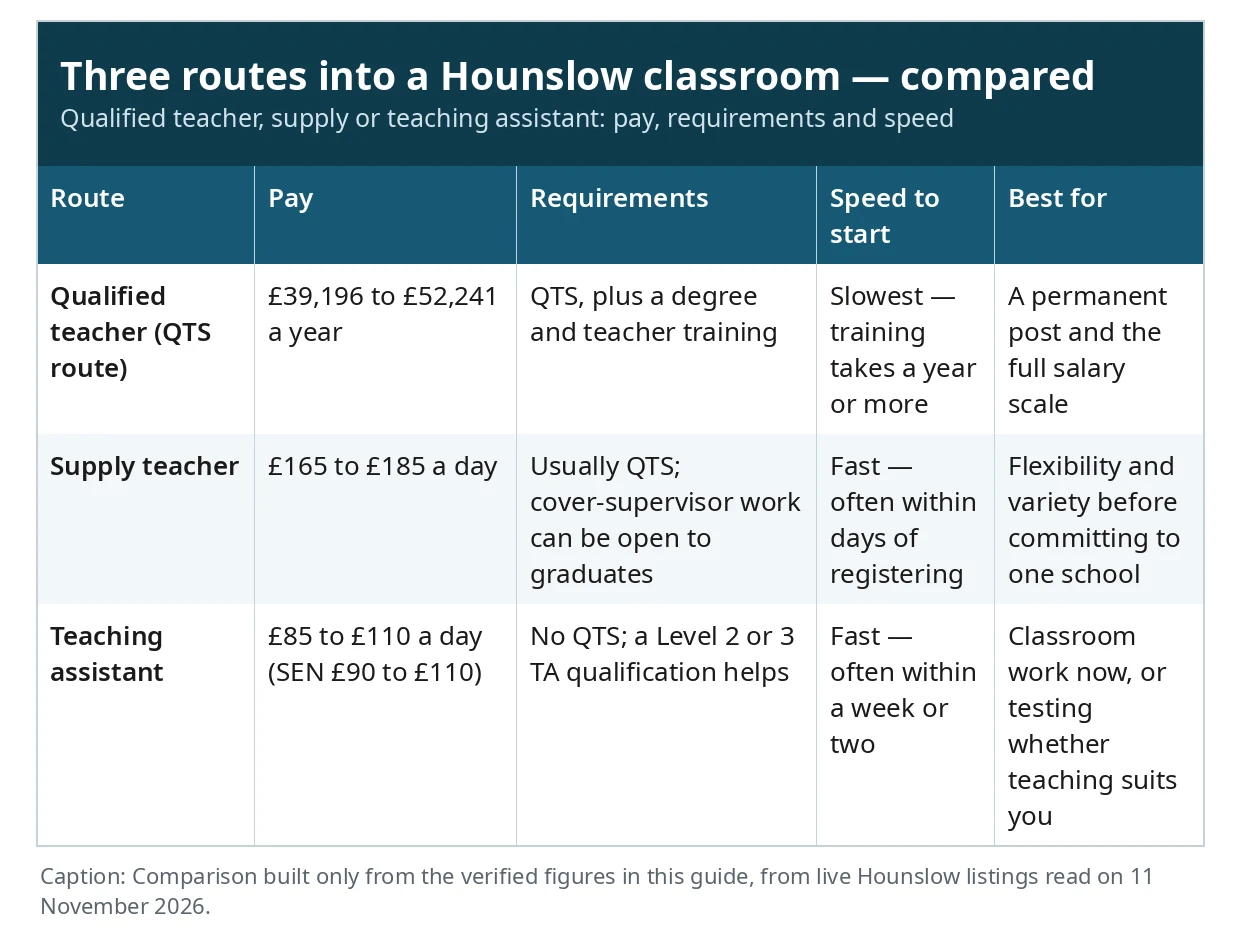
There are three honest ways into a Hounslow classroom, and they suit different people. The comparison below uses only the verified figures from this guide, all from the listings.
- Qualified teacher (QTS route): Pay £39,196 to £52,241 a year on the Outer London main scale. Requirements: Qualified Teacher Status, plus a degree and teacher training. Speed to start: the slowest route, because training takes a year or more, but it is the only route into a permanent classroom-teacher post. Best for: anyone who wants teaching as a career, a permanent contract and the full salary scale.
- Supply teacher: Pay £165 to £185 a day for primary supply, with secondary and cover work in the same band. Requirements: usually QTS, though cover-supervisor work can be open to graduates without it. Speed to start: fast, often within days of registering, because schools call supply teachers when a gap opens. Best for: qualified teachers who want flexibility, variety, or a way into a borough before committing to one school.
- Teaching assistant: Pay £85 to £110 a day, and £90 to £110 a day for SEN teaching assistants. Requirements: no QTS needed; a Level 2 or Level 3 teaching-assistant qualification helps, and experience with children matters more than certificates. Speed to start: fast, often within a week or two of applying. Best for: anyone who wants classroom work now, without a year of training, or who wants to test whether teaching suits them before training.
Choosing between them is mostly a question about time. If you can give a year to training, the qualified route pays the most over a career. If you need income this month, supply or an assistant post starts paying within days, and both let you learn the borough's schools from the inside. A teaching assistant who spends a year in a Hounslow primary knows more about the job than any course can teach, and that year is often why a later training application succeeds. A term of supply across five or six Hounslow schools is a tour of the borough, and it tells you which schools you would actually want to work in.
One opinion worth stating plainly: the teaching-assistant route is underrated, and Hounslow is a good place to take it. The borough's schools advertise assistant posts constantly, the pay is honest for the hours, and a year as an assistant is the cheapest possible test of whether you want a classroom for a career. In a Hounslow primary it is the job that holds the classroom together, and headteachers notice the assistants who do it well. If you are unsure about training, start there.
Before you choose, shape the application for the route you pick: a CV for a qualified post and a CV for an assistant post are not the same document. Our free CV builder puts either one into UK shape without charging you; the paid plans, Basic at $2 and Premium at $4, only add more of the same tools.
How do you get QTS and start teaching in Hounslow?
Qualified Teacher Status, QTS, is the professional standing that lets you teach in most maintained schools in England, and Hounslow's maintained schools are no exception. If you want a permanent classroom-teacher post in the borough, QTS is the credential to aim for. The official government service that explains the routes is Get Into Teaching, and its site lists the paths plainly: train to teach with a degree, train to teach without a degree, a teacher degree apprenticeship, and assessment-only QTS for experienced teachers without the formal status. Read the options on Get Into Teaching, the official Department for Education service, live-verified on 11 November 2026, and use its free one-to-one advice before you commit to a route. The service exists to answer exactly the questions this section cannot: which route fits your degree, your experience and your finances.
The most common route is a year of postgraduate teacher training, usually a PGCE (Postgraduate Certificate in Education), through a university or a school-centred programme. You train in a school, teach real classes under supervision, and come out with QTS. The apprenticeship route lets you earn while you train, which suits career changers who cannot afford a year without income. Assessment-only QTS is the shortest path, but only if you already have substantial classroom experience and a school willing to assess you. Most schools care far less about which route you took than that you hold QTS and can teach.
Two practical steps sit alongside the training itself. First, the DBS check. Every classroom role in England requires an enhanced Disclosure and Barring Service check, and you cannot start in a classroom without one. It is arranged through the school or the agency, not something you buy yourself, and it takes days to weeks, so start it early and keep your identity documents ready.
Second, the timing. Training courses mostly start in September, and applications open the autumn before. If you want to train from September 2027, the time to apply is now, while the January 2027 school vacancies are also live. The two timelines run side by side, and people who plan both at once are the ones who land smoothly.
A word on money while training, since it decides more applications than any other factor: some subjects attract bursaries, and salaried routes pay you while you learn. The details change every year, so check the Get Into Teaching site for the current figures rather than trusting any article, including this one. And do not pay anyone for a teaching job, a training place or a guaranteed post. Real training routes are free to apply for, and real schools never charge you to be considered.
If you are applying for roles while you train, read our guide on how to apply for jobs online for the mechanics of searching, shortlisting and tracking applications, which is the part people usually rush and then regret.
How do you apply for Hounslow teaching jobs, step by step?
Apply in this order, and do not skip a step to save time. The steps are small, and skipping one is what costs people interviews.
First, pick the route and the age group. Primary or secondary, qualified or supply or assistant, mainstream or SEN. A Hounslow primary and a Hounslow secondary are different workplaces, and an application that could go to either one will convince neither. Second, search by the borough, not by London as a whole. "Hounslow" in the location box, and the age group or subject in the keyword box. Third, read the advert twice: once for the role, once for the school. Note the start date, the contract type and the pay band, and check whether the school is named. January 2027 starts are live now, so if you can start in January, say so early in your application. Schools filling a January gap move quickly, and a candidate who can start on time beats a stronger candidate who cannot.
Fourth, shape your CV for that one role. A UK teaching CV is usually two pages: contact details, a three-line profile, work history most recent first, training and certificates with dates, and availability. Name the school, the role and the town in your cover note, and say in two or three sentences why this school and not any school. Do not include a photograph on a UK CV, and do not list a salary expectation. Our guide to the UK CV format sets out the shape in full.
Fifth, line up your references before you apply, not after. One should be a previous employer or supervisor who can speak about your day-to-day work with children, not a family friend. Tell your referees you are applying, and make sure they will answer the phone. Sixth, apply direct to the school whenever you can, through its own careers page or application form. Direct applications reach the people who actually hire. If the post is advertised through an agency, apply through the agency and say clearly which role and school you mean. Seventh, prepare for the interview, which for teaching usually includes a short taught lesson. Our job interview checklist covers the preparation; the single best preparation is a lesson you have actually rehearsed, with a plan for when it runs short or a child asks the question you did not expect.
What does a teaching week in Hounslow actually look like?
Take a Tuesday in a Hounslow primary school, in a Year 4 class, because Tuesdays are the most ordinary day of the week and ordinary days are the truth of the job.
The teacher arrives a little after eight, before the children, and the first job is the classroom: whiteboard ready, books out, the day's plan on the desk. Registration is at a quarter to nine, and the register is not paperwork. It is the moment you learn who is missing, who looks tired, who had a bad morning at home. By nine the class is into English, and the morning runs on a rhythm of whole-class teaching, group work and one-to-one help for the children who need it most.
Mid-morning is the part nobody photographs. A child who struggles with reading gets ten minutes of your undivided attention while the rest of the class works in pairs. A teaching assistant takes a small group for phonics, and you mark yesterday's maths books during assembly, because that is when the marking gets done. Lunch is twenty minutes with colleagues in the staffroom. The afternoon is science and topic work, then reading time, handover notes, and a word with a parent at the gate. You leave at half past five with a bag of books to mark, and that bag is the part of the job that surprises new teachers most. The teaching is the visible half. The marking and planning is the other half, and it happens at home.
A secondary week runs differently: your subject across year groups, so a Tuesday might mean Year 7 in the morning, Year 10 after lunch and a Year 12 seminar last period, each in a different room. Hounslow sits on the Piccadilly line, and a teacher living in central London or the borough itself can reach most of its schools without a car, which is one reason the borough holds on to its teachers. Supply teachers live a third version of the week: a different school each day, a new class each morning, and the skill of walking into a room of thirty children you have never met and having them working within ten minutes.
The honest summary is that teaching in Hounslow is steady, useful work in busy classrooms, and the borough's schools are not short of demand for good people. The January starts in the live listings are proof of that demand, and they are the opening this guide is built around.
Can overseas teachers work in Hounslow schools?
Yes, if the school can sponsor you. The route is the Skilled Worker route: the school must hold a sponsor licence, the role must meet the rules, and the school must be willing to sponsor that hire. Apply the test in order. First, is the school licensed? Search it on our free sponsor directory before you apply. Second, does the role fit the rules? Third, is the school actually hiring for it now? Our guide to companies providing sponsorship in the UK works through the licensed-employer landscape.
One clarification saves a lot of confusion. The closure of overseas recruitment for care workers and senior care workers on 22 July 2025 does not apply to teaching. That closure covers occupation codes 6135 and 6136, which are care roles, and it has nothing to do with classroom teachers. If someone tells you that teaching sponsorship closed in July 2025, they are mixing up two different parts of the immigration rules, and you should not plan around their version. Check the school, check the licence, and check the current rules on the day you apply.
Overseas-trained teachers should also check how their qualification maps to QTS before applying, because the recognition of an overseas teaching qualification is a separate question from the visa. The Get Into Teaching service covers that question, and its free advisers are the right people to ask. Do not pay anyone for a certificate, a job offer or a guaranteed visa. A sponsor must never charge you for a Certificate of Sponsorship, and anyone asking for payment for one is running a scam. Keep the messages and report the advert where you found it.
What should you do next?
Three steps, in order, and the first one takes ten minutes. First, open our live jobs board and search for Hounslow teaching posts. The board holds 8,530 checked jobs, verified live on 11 November 2026, each taken from a company's own careers page and re-checked daily. Filter for Hounslow and note the January 2027 posts, because those are moving fastest. Second, put your CV into UK shape with the free CV builder, and line up your references. Third, if you are training, apply for your training route now, while the school vacancies are live.
The free tools on PakkiNaukri are genuinely usable without paying anything; the paid plans, Basic at $2 and Premium at $4, only add more of the same tools — see the pricing page. Your next step is specific: open the jobs board, find one real Hounslow teaching post that fits your route, and check the school on the sponsor directory if you need a visa. If it fits, apply today, while the January posts are still open.
Frequently asked questions
Do I need QTS to teach in Hounslow?
Yes, for most permanent classroom-teacher posts in maintained schools in England, including Hounslow. Supply teaching usually needs QTS too, though cover-supervisor work can be open to graduates without it, and teaching-assistant posts do not need QTS. Check the routes on the Get Into Teaching service before you commit to training.
How much does a Hounslow teacher earn?
Live Hounslow listings read on 11 November 2026 show qualified teacher posts at MPS1 to MPS6, Outer London, at £39,196 to £52,241 a year. Supply pays £165 to £185 a day, and teaching assistants earn £85 to £110 a day.
What does supply teaching pay in Hounslow?
Live Hounslow listings on 11 November 2026 show primary supply at £165 to £185 a day. A supply teacher's yearly income depends on how many days they work, because the work is not guaranteed every school day, so the daily rate is the honest figure to compare.
Can I start teaching in Hounslow in January?
Yes. January 2027 starts are already advertised in live Hounslow listings, including Key Stage 2 and secondary posts, and schools filling a January gap move quickly. If you can start in January, say so early in your application.
Can overseas teachers apply for Hounslow teaching jobs?
Yes, if the school holds a sponsor licence and the role meets the Skilled Worker rules. Check the school on the free sponsor directory before you apply. The 22 July 2025 closure of overseas recruitment for care workers does not apply to teaching.
Put it to work on real, checked jobs.
Every job on PakkiNaukri is taken from a company’s own careers page and re-checked daily, and a free account scores each one against your CV. Start with today’s list.