
Job Interview Checklist: Before, During, After
Published Oct 24, 2026
A simple interview checklist: what to do days before, the night before, on the day, which questions to ask, and how to follow up after.
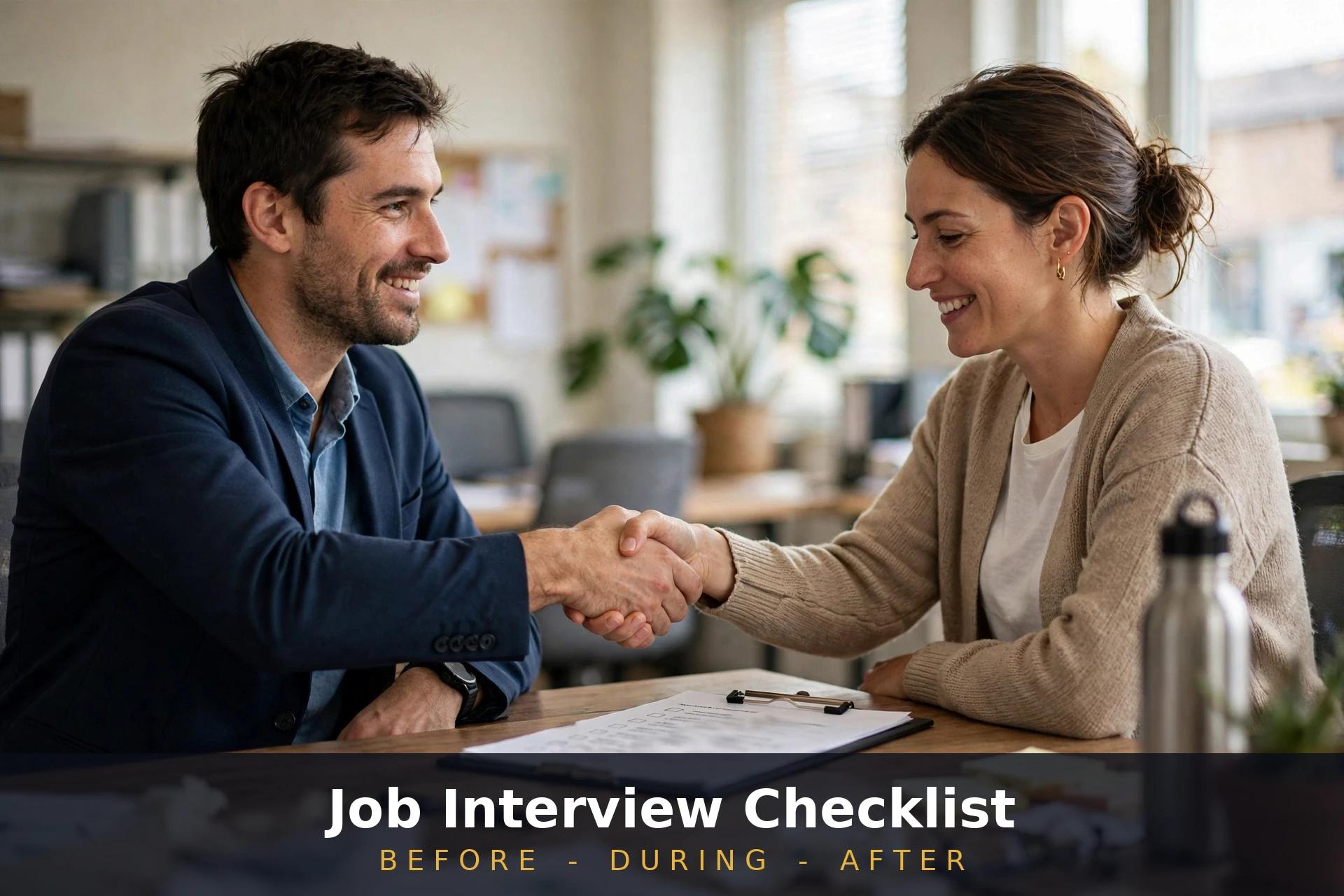
Good interview preparation is mostly simple things done on time. Learn a little about the company. Prepare true examples from your own work. Sort your clothes, documents, and journey the day before. Arrive a bit early, answer clearly, and follow up with thanks. This checklist walks you through each stage in order.
What an interview really is
An interview is a short meeting with one purpose: two sides deciding whether they can work together. The employer is testing three things. Can you do the work? Will you stay and be steady? Will you fit with the people already here? You are testing things too: Is this job what the advert said? Are these people fair? Can you see yourself here? Both sides are deciding. Remembering that takes some of the fear away.
No interviewer expects a perfect performance. They expect a prepared one. Most people who fail interviews do not fail on skill. They fail on small, fixable things: they arrive late and flustered, they cannot explain their own CV, they have nothing to ask, or they never followed up. Preparation is how you remove those failures before the day — so the person the interviewer meets is the real you, not a stressed version of you.
There is no trick to this, and that is good news. You do not need special training or clever lines. You need a few days of steady work: research, examples, logistics, rest. This checklist is split into the days before, the day itself, and the time after — because each stage has its own jobs, and doing them in the right order keeps the last day calm.
Is this checklist right for you?
Yes, if this is your first job interview — the steps here cover what nobody tells beginners, like what to carry and when to arrive. Yes, if you have been out of work for a while and feel rusty: a structure to follow is exactly what brings the polish back. Yes, if you are changing fields: preparation is how you build the bridge between your old work and the new role, out loud, before they ask.
It also helps if interviews have gone badly before. Most bad interviews have a cause you can name — lateness, a blank mind on a simple question, a journey that went wrong. This checklist is built to kill those causes one by one. What it will not do is act for you. There are no lines to memorise and no fake answers to learn. Interviewers hear borrowed lines every week, and they can tell. Your own true examples, prepared well, will always beat someone else’s script.
A few days before: learn about the company
Start with the job advert. Read it again, slowly. Mark the main skills and duties it names, because the interview will come back to them. For each one, think of a time you did that thing, or something close to it. You are building a small stock of true stories. The interview will draw on that stock again and again.
Then learn about the company. Look at its own website: what it does, who it serves, where it works. If it has news or recent posts, read a couple. You are not studying for an exam — you just want two or three real facts you can mention with ease, and a fair sense of what kind of place it is. If a friend or relative works there, or knows someone who does, ask what the place is like. First-hand word is worth more than any page.
Prepare for the opening question, because it nearly always comes: “Tell me about yourself.” They do not want your life story. They want a one-minute summary: what you do now or did last, your strongest relevant work, and what you are looking for next. Practise saying it out loud until it feels plain and easy. Then prepare the other common ones: Why do you want this job? What are your strengths? Tell me about a hard problem at work and what you did. Short, true, specific answers — you will find more on answering well in its own section below.
Finally, write down your questions for them. There is a list further down. Having questions ready matters: it shows real interest, and the answers tell you whether this job is truly right for you. If your CV still needs work before all this, start with our guide to writing a CV that gets replies — the interview is mostly a talk about that document.
If you can, practise once with another person. Ask a friend or a family member to put the common questions to you, and answer out loud, in full sentences. It will feel awkward. That awkwardness is the point: the first time you say an answer should not be in front of the employer. You will hear which answers run too long, which stories do not land, and which questions catch you out. Fix those in the practise, not in the real room. Even one short run-through is worth more than another hour of silent reading, because interviews are spoken, and spoken skill only grows by speaking.
The day before: remove every surprise
Almost everything that goes wrong on interview day goes wrong before you reach the building. The day before is when you prevent it.
- Plan the journey. Check the route and how long it takes, then aim to arrive ten to fifteen minutes early. Have a backup plan if the bus is late or the road is closed.
- Confirm the details. Check the time, the place, and the name of the person you are meeting. If anything is unclear, ask politely today — not tomorrow morning.
- Lay out your clothes. Clean, neat, and suited to the workplace. A little smarter than the everyday dress of the job is a safe choice. Trying them on today beats a nasty surprise at dawn.
- Prepare your documents. Printed copies of your CV, your identity card, and any certificates the employer asked for, all in one folder or bag.
- Save the employer’s address and phone number in your phone, and charge the phone. If you are delayed, one early call can save the interview.
- Read your own CV once more, so that everything on it is fresh in your mind.
- Sleep properly. A rested mind answers better than a tired one that stayed up all night memorising speeches.
If the interview is by phone or video, the same idea applies in a smaller space: test the link or the signal, charge the device, sit somewhere quiet with a plain background, and keep your CV and a pen beside you. Arrive in the call a few minutes early, just as you would at a door.
On the day: from the door to the chair
You are being judged from the moment you arrive, and that is not a threat — it is a chance. Reception staff, guards, and helpers are part of the workplace, and how you treat them is noticed. Be polite to everyone. It costs nothing, and it is remembered.
Greet the interviewer by name if you know it, with a smile and a brief, firm handshake where that is the custom. Sit down when invited, sit comfortably, and put your phone away, on silent. Keep your bag and papers tidy and out of the way. Small order on the outside helps you feel order on the inside.
During the talk, listen fully before you answer. Many people lose marks by answering a question the interviewer did not ask, because they jumped in early. A short pause before you speak is fine — it looks like thought, because it is. Speak at a calm pace. If you speak too fast when nervous, slow down on purpose for the first two answers; the rest will follow.
About nerves: expect them, and do not treat them as a bad sign. Nearly everyone is nervous in an interview, and interviewers know it — a shaky first minute is forgiven before it happens. Nerves also mean you care, and caring is a quality employers want. The way through is not to fight the feeling but to have so few surprises left that there is little for nerves to feed on. You know the route, the clothes, the names, your stories, and your questions. All of that was settled before today. What is left is a talk — and talks, you have had all your life.
Watch the simple things. Make eye contact most of the time, but do not stare. Sit up, but do not sit stiff. If you do not understand a question, say so and ask for it in other words — that is always better than guessing and answering the wrong thing.
How to answer questions well
Most interview questions are versions of a few themes: Can you do this work? Have you done it before? How do you handle trouble? Will you fit here? When you hear the question behind the question, answering gets easier.
For questions about past work, use a simple order in your answer: the situation, what you did, and how it turned out. For example: the delivery van broke down on a busy morning (situation); you called the office, moved the urgent parcels to a colleague’s route, and finished your own round by evening (what you did); no customer was left waiting (the result). That shape keeps an answer clear and complete in under a minute. Long, wandering answers lose the listener; this shape never does.
Be honest about what you do not know. If a question is beyond you, say what you do know, then say how you would find out or learn it. “I have not used that machine, but I learned a similar one in my last job, and I pick up equipment fast” is a strong answer. A bluff is not: interviewers test bluffs, and one caught bluff poisons every true thing you said before it.
If salary comes up, stay calm. It is fair to say you would like the pay that matches the role and your experience, and to ask what range the company has set for the post. If you are offered the job on the spot and need time, say so politely and agree a time to reply — then reply at that time. Your word, kept, is part of the interview even after you leave the room.
Questions you can ask them
An interview is your chance to check the job, not just to be checked. Choose two or three of these, and save them for the end unless the talk turns to them sooner.
- What would I be doing in a normal week in this role?
- Who would I report to, and who would I work with most?
- How will you know, after a few months, that the person in this job is doing well?
- Why is this post open — is it new, or did someone leave it?
- Are there busy seasons or shifts I should know about?
- What are the next steps, and when should I expect to hear from you?
The last question matters more than it looks. It gives you a date, so you are not left guessing and checking your phone for weeks. Avoid asking about pay, leave, and perks in a first interview unless the employer raises them. Those talks go better once they have decided they want you — and asking them too early can sound like the job itself comes second.
What can go wrong — and how to handle it
Even with good preparation, things can wobble. Here is how to handle the common ones without panic.
If you are running late despite everything, call as early as you can, say plainly that you are delayed, give your new time, and apologise once. Many interviews have been saved by one honest call; many have been lost by silence and a late, breathless arrival.
If your mind goes blank on a question, do not fill the silence with noise. Say, “Let me think for a moment,” and take the moment. If the blank stays, say what you can and offer the honest edge of it: “I have not done exactly that, but the closest thing I have done is…” Interviewers would rather wait ten seconds for a real answer than hear a fast, empty one.
If you are asked something you did not expect at all — a strange puzzle, a personal question — stay steady. Answer the work part of it as well as you can. You do not need to share private details that have nothing to do with the job; a polite “I would rather keep the focus on the work” is acceptable.
If the interview goes badly in your eyes — a spilt drink, a stumbled answer — do not write the day off in the room. Recover, finish well, and let the follow-up repair the rest. One bad minute rarely decides anything. Giving up visibly does.
After the interview: follow up the right way
Your work is not done when you walk out. On the way home, write down what was asked, what you answered, and anything you want to remember about the role. Memory fades fast, and if there is a second interview, those notes are gold.
The same day or the next, send a short thank-you message. Thank them for their time, name one specific thing you discussed, and say plainly that you want the role. Three or four lines is enough. It is a small courtesy that many applicants skip, which is exactly why it stands out.
If you promised anything — a document, a reference, a sample — send it promptly. This is the first real test of how you work, and they know it. Then wait for the date they gave you. If that date passes with no news, one polite message asking about the position is reasonable. After that, let it rest and keep applying elsewhere. If the answer is no, stay gracious. Companies remember courteous candidates, and the same firm may hire again. Your record of applications will help you here — our guide on how to apply for jobs online shows how to keep that list and follow up the right way. And on this board, every listing is checked, so the next application starts from solid ground.
What to do next
Do not wait for an interview invitation to start. Pick the next job you are chasing — or a past advert if you have none live — and run through this checklist against it today: the research, the examples, the questions. Preparation done once becomes a habit, and the habit is what makes the real day feel easy.
When you are ready to find that next interview, browse today’s checked jobs, where every listing is re-checked daily, and apply with your CV prepared and your questions ready. If a posting looks suspicious along the way, our guide on how to spot ghost jobs will help you avoid wasting an application. And if anything on the site itself is unclear, the help page has the answers and a way to reach us. Preparation cannot promise you an offer — nothing honest can. But it removes the failures you never needed to have, and that is how ordinary applicants start looking like strong ones.
Recruitment interviews work the same way, with a role play on the phone: our guide to recruitment jobs in Wolverhampton explains what to expect and what to ask about the desk.
Frequently asked questions
What should I take to a job interview?
Printed copies of your CV, your identity card, and any certificates the employer asked for, all in one folder. Also save the employer’s address and phone number in your phone, so one early call can save the day if you are delayed.
How early should I arrive for an interview?
Plan to arrive ten to fifteen minutes early. That gives you time to settle, find the right room, and greet people calmly. Arriving far earlier can be awkward for the staff receiving you; arriving late without a phone call is far worse.
What if I do not know the answer to a question?
Be honest. Say what you do know, then explain how you would find out or learn it. Interviewers test bluffs, and one caught bluff ruins the true things you said earlier. A clear “I have not done that yet, but here is how I would start” is a strong answer.
What questions should I ask at the end of an interview?
Ask about the work itself: what a normal week looks like, who you would report to, how success in the role is judged, why the post is open, and what the next steps and dates are. Save pay and perks for later, unless the employer raises them first.
Should I send a message after the interview?
Yes — a short thank-you the same day or the next day. Thank them for their time, mention one specific thing you discussed, and restate your interest in the role. Three or four lines is enough. It is a small courtesy many applicants skip, which is exactly why it stands out.
Put it to work on real, checked jobs.
Every job on PakkiNaukri is taken from a company’s own careers page and re-checked daily, and a free account scores each one against your CV. Start with today’s list.