
Recruitment Jobs in Wolverhampton: Guide
Published Nov 11, 2026
Recruitment jobs in Wolverhampton: pay, trainee routes, sectors hiring and how to apply — with live listing figures checked on 11 November 2026.

Recruitment jobs in Wolverhampton: the honest answer first
Recruitment jobs in Wolverhampton are open to beginners as well as experienced consultants. Live listings on 11 November 2026 show experienced consultants advertised at £30,000 to £50,000 a year plus uncapped commission, trainee roles with no experience required, and in-house internal recruiter posts at £29,000. The city hires across industrial, education, construction, healthcare and commercial desks.
That is the short version. The longer version matters because recruitment is one of the few office careers in a city like Wolverhampton where the door is genuinely open to people with no degree and no experience, and also one of the few where the pay on the advert is only half the story. The other half is commission, and it changes the maths completely. This guide works through both halves, with figures from live Wolverhampton listings read on 11 November 2026.
A recruitment job is a job where you find people for employers: you take a vacancy from a company, find and interview candidates, and place the right person, usually for a fee the employer pays your agency. It is a sales job with a human being at the centre of every deal. The phone never stops, targets are counted, and a good week can pay far more than the salary on the advert.
PakkiNaukri is a free job board and CV builder for job seekers in Pakistan and for visa-sponsorship jobs in the UK, USA, Europe, the Gulf, Australia and New Zealand. Our live jobs board holds 8,530 checked jobs, verified live on 11 November 2026, and you can search it for Wolverhampton roles today. The board takes its listings from companies' own careers pages and re-checks them, so what you see is what the employer actually posted.
Wolverhampton is a city in the West Midlands, and the recruitment work here follows the city's employers. A recruitment desk lives or dies on the companies around it, and in Wolverhampton those companies are manufacturers, schools, builders, care providers and commercial firms.
What is a recruitment job, in plain words?
A recruitment job is three things done in a loop: find a vacancy, find a person, and put the two together before someone else does. The vacancy comes from an employer who needs staff. The person comes from adverts, phone calls and recommendations. The placement happens when the employer offers the job and the candidate accepts it. Your agency then earns a fee, and a share of that fee comes back to you as commission.
There are three shapes of the role, and they pay and feel very differently. The first is the 360 recruitment consultant, who runs the full cycle: win the client, take the vacancy, find the candidates, interview them, arrange the employer's interviews, negotiate the offer, and stay in touch until the person starts. It is the hardest version of the job and the best paid, because you carry both sides of the deal.
The second is the delivery or resourcing consultant, who works on the candidate side only, finding and screening people for vacancies other consultants have won. It is steadier, with less commission. The third is the internal recruiter, who works inside one employer, hiring only for that company, on a fixed salary with no agency commission at all.
A trainee recruitment consultant is a beginner learning the 360 cycle, usually on one desk with a manager close by. Live Wolverhampton listings on 11 November 2026 show trainee posts advertised with no experience required beyond communication skills and sales aptitude. That is a real open door, but go through it with your eyes open: the first months are mostly phone calls, most of them unanswered. People who enjoy talking to strangers do well; people who dread the phone do not.
A recruitment consultant reads CVs for a living, so yours will be judged harder than in most trades. A hiring manager in a recruitment agency reads hundreds of CVs a week and spots a copied template in seconds. Keep yours short, plain and true, two pages at most, with your newest work first. Our free CV builder puts a CV into the UK shape hiring managers expect, and it costs nothing to use.
How much do recruitment jobs in Wolverhampton pay?
Here is the pay picture, worked from live Wolverhampton listings read on 11 November 2026, not from a salary website's estimate. Experienced recruitment consultants in the city are advertised at £30,000 to £50,000 a year in base salary, plus uncapped commission. An internal recruiter post is advertised at £29,000 a year, fixed, with no commission mentioned. A related role, an HR advisor in the Midlands working hybrid, is advertised at £30,809 to £37,505 a year. Trainee adverts read on the same day did not state a salary at all, which is common: the number is discussed at interview.
Now do the arithmetic, because the advert's headline number hides the real comparison. At the bottom of the advertised consultant band, £30,000, the base salary is only £1,000 above the internal recruiter's £29,000. At that level, the difference between the two jobs is not the base pay at all: it is the commission. A consultant on £30,000 who places people regularly earns well above the internal recruiter; one who places nobody earns £30,000.
At the top of the band, £50,000, the consultant's base alone is £21,000 above the internal recruiter's £29,000, and commission still sits on top of that. The HR advisor range, £30,809 to £37,505, sits inside the consultant band but is fixed, with no commission to chase and no placement target to miss. So the real question is whether you want a fixed salary, or a smaller one with an uncapped extra that depends on your results.
Commission is commonly uncapped on top of base salary in agency recruitment, which means there is no ceiling written into the contract. Uncapped also means unguaranteed. The adverts that quote an "OTE", an on-target earnings figure, are quoting a hope, not a promise. Always ask what consultants on that desk actually earned last year, before you accept.
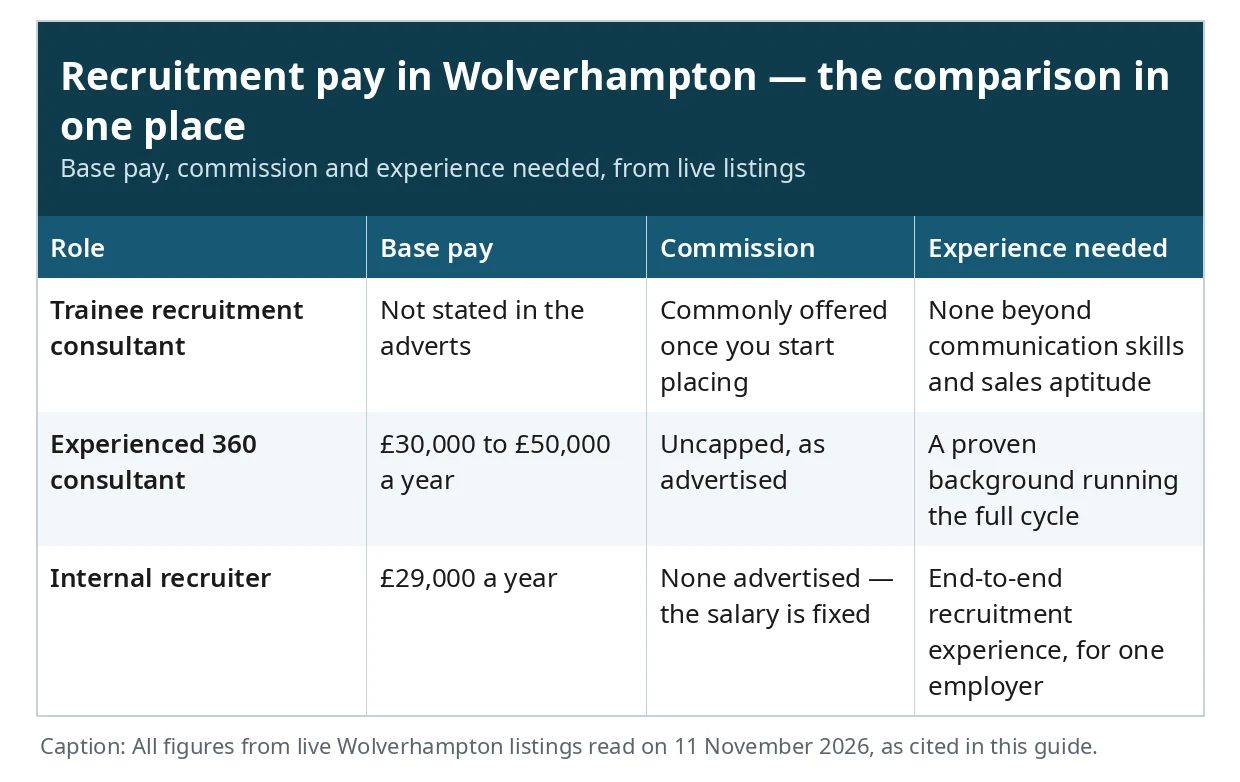
The comparison in one place, built only from the figures above:
- Trainee recruitment consultant: base pay not stated in the adverts. Commission commonly offered once you start placing. Experience needed: none beyond communication skills and sales aptitude.
- Experienced 360 consultant: base pay £30,000 to £50,000 a year. Commission uncapped, as advertised. Experience needed: a proven background running the full cycle.
- Internal recruiter: base pay £29,000 a year. Commission none advertised; the salary is fixed. Experience needed: end-to-end recruitment experience, working for one employer rather than an agency.
One more honest note on pay. As a general pattern, January and September are the busy months and December goes quiet, and a desk that hires for schools follows the school year. A consultant's income follows the same rhythm. If you need the same money every month to pay rent, the fixed internal recruiter salary at £29,000 is the safer shape, even though the agency desk can pay more in a good year. The pay question most people forget to ask is the one that decides whether the job is good: how much of that commission do people on this desk actually earn? We come to that in the section on what to check before you accept.
How do you get into recruitment in Wolverhampton with no experience?
You have five routes in, and the National Careers Service lists all five: a university course, a college course, an apprenticeship, working your way up, and applying directly.
A degree in most subjects can lead in, and some employers prefer a related subject, like human resources or marketing. A college course in business studies or business administration can get you an assistant post in an agency. You can apply for a Recruiter Level 3 Advanced Apprenticeship, which takes up to two years and mixes on-the-job learning with time at a training provider; you will usually need five GCSEs at grades 9 to 4, including English and maths. You can start as an admin assistant and work your way up. Or you can apply directly if you have experience in a similar field. That picture comes from the National Careers Service profile for recruitment consultants, live-verified on 11 November 2026.
For most people reading this guide, the direct route is the one that matters. Trainee posts in Wolverhampton are advertised with no experience required, and agencies hire for attitude and phone manner more than for paper. What they test is whether you can talk to a stranger, listen properly, and keep going after a bad call. Retail work, call-centre work, hospitality work and door-to-door sales all teach those things, and a good application says so in plain words instead of hiding the retail job at the bottom of the page. Two years in a shop hitting a weekly target is recruitment experience in everything but name: you found people, understood what they wanted, and closed a sale.
Your application needs three things, and only three. First, a short UK-format CV, two pages, newest work first, with the skills that transfer named clearly. Our guide to a UK CV format that gets replies walks through that shape, and the ATS-friendly CV guide shows how to pass the screening software you will one day operate yourself. Our step-by-step guide to applying online covers the forms and the safety checks. Second, a short note naming the desk or sector you want and why, in two sentences. Third, a phone number you actually answer, because in recruitment a missed call is a missed placement.
With experience, a consultant can move into business development or management, or set up their own agency. The first year teaches you the phone, the second year the desk, and after that you choose whether to manage people, win clients, or run your own shop.
Which sectors in Wolverhampton hire recruitment staff?
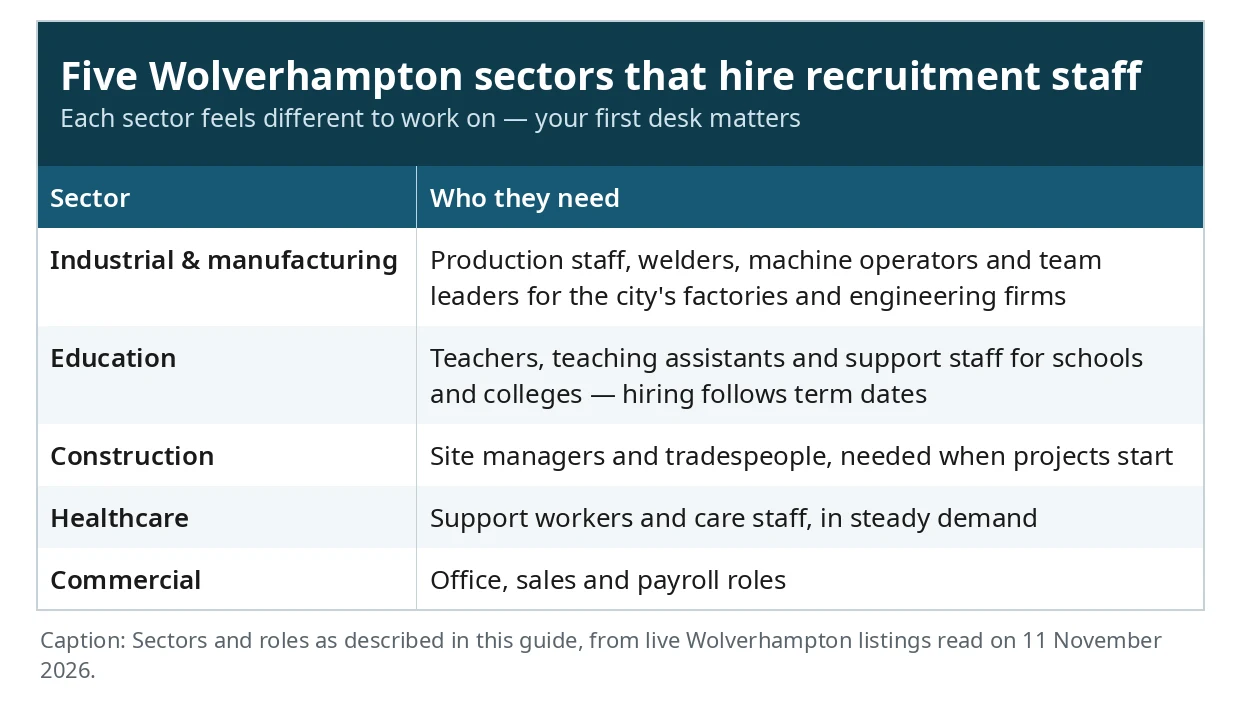
The city hires recruitment staff across five sectors, and each one feels different to work on. Industrial and manufacturing is one of the biggest desks in the city, because the city's factories and engineering firms need production staff, welders, machine operators and team leaders. Education is another big desk: schools and colleges need teachers, teaching assistants and support staff, and the hiring follows term dates. Construction is the third, with site managers and tradespeople needed when projects start. Healthcare is the fourth, with support workers and care staff in steady demand. Commercial is the fifth, covering office, sales and payroll roles.
Your first desk matters more than your first salary. That is an opinion, but it is one this guide will stand behind: a desk in a sector you understand will teach you faster than a higher base on a desk you know nothing about. If you worked in a warehouse, the industrial desk will make sense on day one. If you worked in a school, the education desk will feel natural. If you know nothing about any of these sectors, pick the one with the most vacancies and learn it by ringing people and asking plain questions.
A note for readers applying from outside the UK: some Wolverhampton employers hold sponsor licences and some do not, and the desk you join decides which kind of employer you meet. Before you invest weeks in applications, check whether the employers hiring in your sector can sponsor at all. Our page on companies providing sponsorship in the UK explains the licensed-employer landscape, and the sponsor directory itself is free to search by town or city.
The seasonal pattern is worth planning around. As a general pattern, January brings new budgets and new vacancies, September brings school-term hiring, and December goes quiet. If you apply in January, expect faster replies. If you apply in December, expect silence and do not read it as rejection.
How do you apply for recruitment jobs in Wolverhampton?
Apply in this order, and do not skip steps. First, get your CV into UK shape, two pages, PDF, newest work first. Second, search the live listings for Wolverhampton and shortlist the trainee posts that match what you can do. Third, apply direct through the employer's own careers page wherever you can, because a direct application reaches the people who actually hire. Fourth, register with a couple of local agencies, because they hold many of the live vacancies. Fifth, follow up once after a week if you have a contact, and then let it rest and keep applying. The forms and safety checks are covered in our online application guide.
Here is the week, built for one real kind of applicant. Say you are twenty-two, living in Wolverhampton, working in a shop, and you have never had an office job. Monday, you rewrite your CV around the parts of the shop job that transfer: you hit a weekly sales target, you dealt with unhappy customers, you opened and closed the shop, and you trained two new starters. Tuesday, you apply to three trainee recruitment posts, each with a two-sentence note naming the sector you want and why. Wednesday, you phone one local agency and register, and you answer every question about your availability plainly. Thursday, you practise the interview out loud once. Friday, you check your email and your phone, and you apply to three more posts. Nothing in that week needs money, a degree or a connection.
Where you search matters as much as how you search. The government's own Find a job service searches vacancies across Great Britain, and you can use it from the official GOV.UK Find a job page, live-verified on 11 November 2026. Use it alongside the jobs boards and the agencies, not instead of them, because no single source lists everything. Search with the job title and the town together.
One habit will save you more time than anything else in this guide. Keep a simple list of every application: the company, the role, the date you applied, and the name of anyone you spoke to. An agency will ring about a role you applied to three days ago, and if you cannot remember which one it is, the call goes badly. A list on your phone, updated the same day, is the whole system. It is the difference between sounding prepared and sounding lost.
What happens in a recruitment job interview?
A recruitment interview is different, because the job itself is the interview: the hiring manager is watching how you would sound on the phone to their clients. Expect a short role play, where you are asked to sell something ordinary or to ring a pretend client and open a conversation. Expect questions about targets, and about what you will do when a candidate stops answering their phone on the morning of an interview. Expect to be asked why recruitment, and let a straight answer count for more than a polished one. Our job interview checklist covers the preparation and the follow-up.
Prepare three true stories from your own work, and prepare them properly. The first story should show you hitting a target or a deadline when it was hard. The second should show you handling a difficult person with patience. The third should show you learning something quickly and using it the next day. Those three stories answer most of what an interviewer wants to know, and they are all stories only you can tell, because they happened to you. Borrowed answers fail here: the interviewer hears them every week. Your own true examples will always beat someone else's script.
Ask your own questions at the end, and ask about the things that decide whether the job is good. Which desk would I join? What does a normal week look like? How many placements does a consultant on this desk make in a typical month? What training do you give in the first month? How is commission calculated, and when does it pay? A good manager will welcome them. One who will not answer is telling you something about the desk.
After the interview, send a short thank-you the same day or the next day, naming one thing you discussed. If a week passes with no word, send one short follow-up, then keep applying elsewhere. Never wait on one application.
What should you watch out for before you accept?
Four checks, in order, before you sign anything. First, money: nobody should ever ask you to pay to apply, to register with an agency, or to be put forward for a role. If anyone asks for payment for a placement, a training course, or a guaranteed job, that is a scam, stated plainly.
Second, commission in writing. The base salary is the promise; the commission is the hope, and the difference between them is decided by the small print. Ask for the commission structure in writing before you accept: what counts as a placement, what percentage you earn, when it pays, and whether the agency can claw it back if the candidate leaves early. Ask what consultants on the desk actually earned last year, not what the top earner made in the best month. If the answer is vague, treat the commission as zero when you judge the offer.
Third, targets and probation. Ask how long probation lasts, what the targets are in the first three months, and what happens if you miss them. A fair desk sets targets a beginner can reach with steady work. A desk that sets impossible targets in month one is a revolving door, not a desk.
Fourth, the employer itself. Check that the employer is real: a proper website, a real office, a name you can find in more than one place. If you are applying from outside the UK, there is one more check that decides everything. Only an employer that holds a sponsor licence can sponsor you, and the role itself must meet the rules. Read our guide to sponsorship jobs in the UK, then check the employer on the free UK sponsor directory, which lists 143,071 official Home Office entries from the register dated 4 November 2026, and run the check in our step-by-step guide to checking the sponsor licence list.
What should you do next this week?
Use the free tools first: our free CV builder puts your CV into UK shape, and the free job board is there when a suitable role appears. If you want the fuller set of templates and tools, the plans are Basic at $2 and Premium at $4, and the free tools are genuinely usable without paying anything. Do not pay anyone for a placement or a guaranteed job. The free tools on this site and the official sources linked here are enough to get you started.
Your next step takes ten minutes: open today's Wolverhampton listings on our jobs board and search for recruitment roles in the city, then run the register check from the previous section on any employer you are considering if you need sponsorship. If the role is real and the employer is real, apply today, while the vacancy is fresh. If not, you have saved yourself a week. That is the whole method, and it is the only method that respects your time.
Frequently asked questions
Do I need experience to get a recruitment job in Wolverhampton?
No. Trainee recruitment consultant posts in Wolverhampton are advertised with no experience required beyond communication skills and sales aptitude, based on live listings read on 11 November 2026. The National Careers Service also lists direct application and starting as an admin assistant as routes into the role.
How much do recruitment consultants earn in Wolverhampton?
Experienced recruitment consultants in Wolverhampton are advertised at £30,000 to £50,000 a year in base salary, plus uncapped commission, based on live listings read on 11 November 2026. An internal recruiter post in the city is advertised at £29,000 a year, fixed, with no commission mentioned.
Do I need a qualification to become a recruitment consultant?
No single qualification is required. The National Careers Service lists a degree in most subjects, a college course, a Recruiter Level 3 Advanced Apprenticeship taking up to two years, starting as an admin assistant, or applying directly.
Which sectors hire recruitment staff in Wolverhampton?
Industrial and manufacturing, education, construction, healthcare and commercial, based on live Wolverhampton listings read on 11 November 2026. Industrial and manufacturing is one of the biggest desks in the city.
Can I apply for a recruitment job in Wolverhampton from outside the UK?
Only if the employer holds a sponsor licence and the role meets the Skilled Worker rules. Check the employer on the free UK sponsor directory before you apply, and read our sponsorship jobs guide first.
Put it to work on real, checked jobs.
Every job on PakkiNaukri is taken from a company’s own careers page and re-checked daily, and a free account scores each one against your CV. Start with today’s list.