
Visa Sponsorship Job in the UK: Find One
Published Nov 13, 2026
Find one visa sponsorship job in the UK: pick your role, check the employer on the sponsor register, read the advert, and apply with a UK-style CV.

How do I find a visa sponsorship job in the UK?
Pick one role you can honestly do, check that the employer hiring for it holds a sponsor licence, and make sure the role itself fits the visa rules before you apply. A visa sponsorship job is a real vacancy at a licensed employer, and the employer gives you a Certificate of Sponsorship for that exact job.
That is the whole method. The rest of this guide is the working detail: how to pick the role, how to check one employer properly, how to read a single advert without missing the line that decides everything, and what to do after you apply. Nothing here promises you a job or a visa. What it does is stop you spending weeks on applications that were decided before you sent them.
PakkiNaukri is a free job board and CV builder for job seekers in Pakistan and for visa-sponsorship jobs in the UK, USA, Europe, the Gulf, Australia and New Zealand. The board holds 8,721 checked jobs live, with 211 added today and 618 of them in the UK, counted on 13 November 2026. The sponsor directory underneath it is free too, and the method below uses both, because a search without a licence check is just guessing with better formatting.
Most people search backwards. They type a hopeful phrase into a search box, open the first advert that looks friendly, and send a CV they wrote for a different market. Then they do it forty more times and hear nothing. The system is not closed to them. It is narrow, and it rewards the person who aims at one door that can actually open. This guide is about that one door. If you want the wider picture first, our overview of sponsorship jobs in the UK explains which roles sponsors actually hire for, and our jobs with sponsorship guide covers the general searching method this article builds on.
What is a visa sponsorship job, in plain words?
A visa sponsorship job is a job where a UK employer with a sponsor licence offers you a role and gives you a Certificate of Sponsorship, which everyone calls a CoS. The CoS is not a visa. It is a digital record with a reference number that says this licensed employer is offering you this specific job, and you use that number when you apply for your visa. Without a licensed sponsor and a CoS, the Skilled Worker route does not open at all.
Think of it as a door with two keys. The employer holds one key, the licence. The job itself holds the other, because the role has to meet the skill and salary conditions in force when you apply. Both have to turn at the same time, for the same job.
Sponsorship is not the employer paying for everything, and it is not a promise of a visa. The employer sponsors the job, not your whole life. You still apply for the visa yourself, and the Home Office still makes the final decision. Anyone who tells you a sponsor "guarantees" a visa is either confused or selling you something. Keep that sentence in your pocket. It will save you money.
A big company name does not mean a sponsor licence. A small care provider in Manchester can hold one while a famous shop chain does not sponsor your kind of role at all. Licences belong to a specific legal employer, sometimes to one branch and not another, so check the exact employer name every time.
Which visa route fits the job you want?
Most sponsored jobs travel on one of three roads, and picking the wrong road wastes the whole journey. The Skilled Worker visa is the main one for most professions: you need a job offer from an approved employer, a CoS for that exact job, and a role that sits on the list of eligible occupations and meets the salary conditions. The Health and Care Worker visa covers many health and care roles inside the same sponsored system; it is cheaper to apply for and you do not pay the annual immigration health surcharge. Global Talent is different: it is for people recognised as leaders or emerging leaders in research, arts or technology, and it does not need a job offer in the same way. It suits very few people.
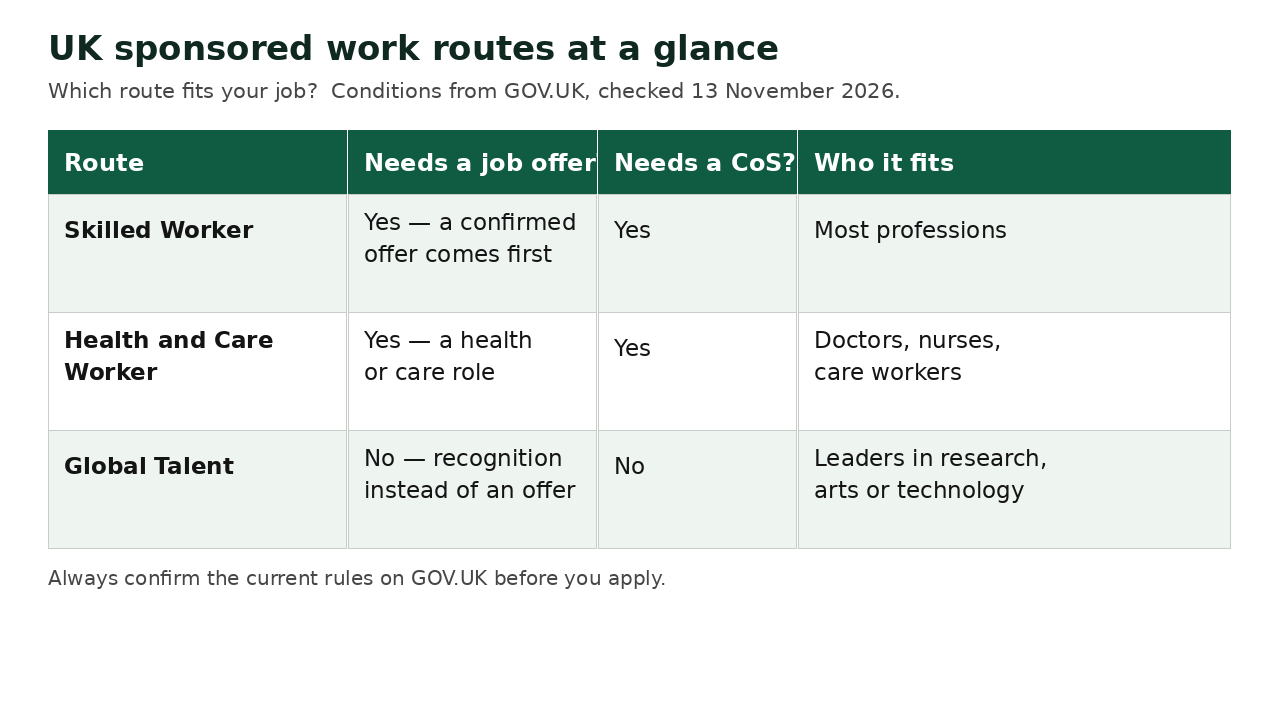
The three sponsored routes at a glance. Conditions from GOV.UK, checked 13 November 2026. Always confirm the current rules on GOV.UK before you apply.
The Skilled Worker facts below come from the official Skilled Worker visa page, read on 13 November 2026. You must have a confirmed job offer before you apply. Your visa can last for up to five years, and after five years you may be able to apply to settle permanently in the UK. You can apply up to three months before your start date, and you must apply within three months of getting your CoS. Once you have applied and proved your identity, you will usually get a decision within three weeks if you are outside the UK, and within eight weeks if you are inside it.
The salary rule is the part people get wrong most often. GOV.UK states the usual requirement is £41,700 a year, or the "going rate" for your job, whichever is higher — checked 13 November 2026, and you should check the current page again before you apply, because this number moves. The page gives an example: your salary is £42,000 a year, but the annual going rate for the job is £45,000. You do not meet the usual salary requirements. The headline number is not the test. The higher of the two numbers is. A lower salary can still qualify in defined cases, at £33,400 a year or more — but do not build a plan on an exception until you have read the exact condition that fits you.
The licence itself costs the employer £611 for small businesses and charities, or £1,682 for medium and large organisations, and it usually takes around eight weeks to process — which is why a small employer may like you and still say no. If you are a care worker or senior care worker in England, your employer must also be registered with the Care Quality Commission.
If your role is health or care, read the Health and Care Worker route first — the cheaper application and the missing health surcharge change the maths for both sides. Our guide to care homes with visa sponsorship walks through that corner properly. Chefs, by contrast, are largely ineligible for new Skilled Worker sponsorship in most ordinary roles — our chef jobs guide sets out the position honestly.
How do I pick the one role to chase first?
Here is where this guide departs from every general guide on the site. The general guides tell you to list the roles you can do. This one asks you to pick one — a single job title, in a single kind of workplace — and chase it until you have proof it cannot work, before you pick another. A sponsored application is not a lottery ticket. Each one costs you a licence check, a CV rewrite, and a careful read of the advert. Ten careful applications beat forty rushed ones, and one role chased properly beats ten roles chased thinly.
Start with what you can honestly do today. Write down the last job you actually held, the tasks you did every day, and the qualifications you hold that a UK employer would recognise. Then ask three questions about that role, in this order.
First, is the role on the eligible occupations list? You need its four-digit occupation code, and if you already have a job offer, the employer can give you the code. If you do not have one yet, the official occupation coding tool lets you search your job title — and the official page warns that not every job title is included, so try similar jobs and make sure the description matches what you would actually be doing. The page gives a sharp example: bricklayers, roofers and carpenters are eligible, but construction labourers are not. Two jobs on the same building site, two different answers. Your title is not your code.
Second, does the pay work? Take the going rate for your occupation code and compare it with the £41,700 figure above. The higher one is your bar. If the adverts you see for your role sit well below that bar, the role is probably not your road, however much you like it. Better to learn that in an afternoon than after six months of applications.
Third, who actually sponsors this role? Do not ask "does anyone sponsor warehouse workers?" Ask "which employers in Manchester sponsor warehouse operatives, and are they hiring this month?" The narrower question has an answer. The wide one only has opinions.
Imagine a hotel receptionist from Lahore with four years behind a front desk — call her Mariam. Instead of applying for every hotel job in London, she picks one role — night receptionist, her real experience — and one city, Manchester. She checks the register for licensed hotel employers there and reads their careers pages only. Her applications fall from thirty a month to five a week, and every one of them lands with an employer who can actually say yes. That is the point of the method: fewer doors, but doors that open.
The offer comes first, the CoS second, the visa third. Never reverse that order, and never pay anyone who offers to reverse it for you.
How do I check one employer, end to end?
This check decides everything, and it takes about two minutes once you have done it once. It also has a trap most people walk into: they check the employer's name on a job board and stop. A board is not the register. The register is the register.
Open the official register of licensed sponsors on GOV.UK, or PakkiNaukri's free searchable copy of it. The copy holds 143,071 licence entries from the Home Office register dated 4 November 2026, and you can search it by organisation name, town or city, and visa route, without signing up. That figure is from our own sponsor directory page, read live on 13 November 2026, and the page itself tells you to confirm an employer's status on GOV.UK before relying on it. Do that. The directory is a fast check, not a final answer.
Search the employer's exact legal name first. Then try the town on its own. Then try a shorter version of the name, without "Ltd" or "Limited". An employer may sit on the register under its parent company name, so if your first search finds nothing, the name you are using may simply be the trading name. A hospital trust often lists under the trust name while its adverts carry a hospital name. If you still find nothing, ask the employer which legal name holds its licence. A real licensed employer answers without fuss. A vague answer is itself an answer.
Read the entry properly when you find it. First, the visa route beside the name: it must cover the route you need, usually Skilled Worker. A licence for one route does not cover another. Second, the rating: an A rating means the sponsor is meeting its sponsorship duties. A B rating means the Home Office has put the sponsor on an action plan, and a B-rated sponsor cannot take on new sponsored workers until it earns its A rating back. Third, the town, which should match the place you would actually work.
Here is what a "yes" actually means, and what it does not. It means the employer holds a licence and can issue a CoS for a role that meets the rules. It does not mean the employer is hiring today, or hiring for your role. That is the next step, and it belongs on the employer's own careers page. A "yes" means the application is worth your time. A "no" means stop. Our step-by-step guide to checking the sponsor licence list walks through the search itself, and the free UK sponsor directory is the tool to do it with.
One live observation is worth keeping. On 13 November 2026, a clean UK search for this exact subject showed a small sponsorship board ranking second on the whole first page, ahead of large employers and official pages. That page is a listings page, not a guide: it shows roles, but it does not walk you through the licence check, the salary rule, or how to read the advert. That gap is exactly what this guide fills. Do the check ten times and it stops feeling like a chore. The people who get sponsored are rarely the people with the longest CVs. They are the people who aimed at employers who could actually say yes.
What does a real sponsored-job advert say, line by line?
Adverts for sponsored roles hide in plain sight. They sit next to roles that will never sponsor anyone, wearing the same clothes. The advert rarely shouts "we sponsor" in the title. You have to read it like a detective, and the clues are small. What follows is a worked read of one advert shape — a warehouse operative post in the Midlands — built from the patterns real adverts use. It is an illustrative example, not a copy of any single live advert, and no employer is named here, because the point is the reading, not the role.
First, the title and the location. "Warehouse Operative — Night Shift, Manchester." The title tells you the role. The location tells you the commute and the rent. A title that says only "Operative" tells you nothing, and a location that says only "UK" tells you less. If the advert hides the town, treat that as a small warning and keep reading.
Second, the right-to-work line. This is the line that decides everything, and it is usually halfway down, not at the top. A green light reads "sponsorship available" or "we hold a sponsor licence". A red light reads "must already have the right to work in the UK" or "we cannot offer sponsorship for this role". Believe the red light. Many people read past it because they like the job. Move on. If the advert says nothing at all about right to work, that is not a green light either. It is a missing line, and the licence check from the last section is how you fill it in.
Third, the duties. Read them against your own last job, duty by duty: picking, packing, loading, scanning, stock checks, forklift work if you hold the ticket. If the advert lists a forklift ticket and you do not hold one, do not claim it. Say what you do hold that sits closest, and let the employer decide. A CV that matches the advert in five honest places beats one that matches in ten invented ones.
Fourth, the pay, the shift pattern, and the application route. Night work pays more than days, and the advert should say so plainly. If the pay is quoted as a range, ask yourself which end you would actually start on. Apply through the employer's own careers page where you can: a role there comes straight from the employer, while a role copied across five boards may be old, closed, or changed. If the employer's own page says something different from the board, believe it, and keep a copy of what you sent.
Where do I apply, and what do I send?
Apply in this order, and do not skip steps. First, get your CV into UK shape: two pages at most, newest work first, no photograph, no age, no marital status, no religion, no national identity number. UK managers do not expect those details, and adding them marks the CV as written for a different market. Our UK CV format guide walks through that shape, and the guide to how to write a CV that gets replies shows how to put your newest work first with real detail.
Second, search the live listings for your one role and your one town, and shortlist the posts that match what you can actually do. A good place to start is the live roles on the PakkiNaukri jobs board, where each listing comes from a company's own careers page and is re-checked daily. The government's own Find a job service is the other official starting point, and you can use it from the official GOV.UK finding-a-job page, live-verified on 13 November 2026. Use it alongside the jobs boards, not instead of them, because no single source lists everything.
Third, apply direct through the employer's own careers page wherever you can, because a direct application reaches the people who actually hire. Fourth, register with a couple of local agencies only if they hold live vacancies in your role — and remember that a real recruiter never charges you a fee for finding you a job. Fifth, follow up once after a week if you have a contact, and then let it rest and keep applying. The forms and safety checks are covered in our step-by-step guide to applying online, and the job interview checklist is worth reading before any call comes, not after.
Your CV has one job: to get you an interview for this exact role, at this exact employer. Give each job two or three lines: what the place was, what you actually did there, and one thing that went well because of you. Numbers help when they are true. Never invent a number. Match the words in the advert, but honestly: if the advert asks for "stock control" and you have it, say so, in those words, near the top. If it asks for a skill you do not have, do not claim it. Say what you do have that sits closest.
Your cover note is shorter than you think. Three short paragraphs do the work. First, name the role, the employer, and why this one. Second, name the two or three things about you that fit this role best, with one concrete example each. Third, say that you would welcome an interview, and give them a way to reach you. A page-long letter that repeats your CV helps nobody.
Here is where a lot of people quietly lose: they send the same CV to a care home, a hospital and a hotel, and wonder why none of them bite. A care home wants to see care, patience and night-shift steadiness. A hotel wants to see guests, rushes and calm under pressure. It is the same person, with different strengths on show. Change the top of your CV for each kind of employer. If you want that done properly without starting from a blank page, our free CV builder puts a CV into the UK shape hiring managers expect, and it costs nothing to use. The paid plans add more templates: Basic is $2 and Premium is $4, and you can see what each adds on the plans page. Start free, and only pay if the paid template genuinely fits the role you are chasing.
Set a weekly number, and keep it small. Keep the number low and the quality high. Keep a simple log — date, employer, role, town, outcome — and after a few weeks it shows you patterns: if care homes in Manchester answer and hotels in London never do, your log just told you where your chances live. The companies providing sponsorship in the UK guide explains the licensed-employer landscape in full.
Which companies sponsor work visas in the UK?
The companies that sponsor work visas in the UK are the licensed employers on the Home Office register of licensed sponsors, and there is no other list that matters. That register, dated 4 November 2026, holds 143,071 licence entries. The only way to know whether one company can sponsor you is to search for its exact legal name on it.
So this section is not a list of company names. A list printed today would be wrong next month, because licences are suspended and revoked between updates, and because a company on the list may hold a licence and still not be hiring your role this year. What this section gives you instead is the honest way to find the companies that matter to you, in three steps that take about ten minutes.
First, search the register by your role, not by company size. Pick your one role and your one town, then look at which licensed employers in that town hire for that role. The sponsor register lets you search by organisation name, town or city, and visa route, and it shows the route and rating beside each entry. Build a list of ten employers from that search, in your sector and in towns you would actually live in. Ten is enough. Fifty is a spreadsheet, not a plan.
Second, sort those ten by whether they are actually hiring. A licence is not a vacancy. Go to each employer's own careers page and look for your role, open now. Cross off every employer with no live vacancy in your role, however famous the name. What is left is your real shortlist: licensed, hiring, in a town you would live in. If nothing is left, widen the town before you widen the role.
Third, learn what kind of sponsor each one is. Large employers usually have a routine — a standard process and a realistic timeline. Small employers may sponsor rarely, and the process may be slower and more personal. Neither is better in itself; what matters is knowing which kind you are dealing with before you apply.
One warning belongs here, because it is where the most money is lost. No company on any list will charge you for the privilege of being on it. A licence check is free. A CoS is free to you. Anyone selling you a place on a sponsor list, or a guaranteed job at a named company for a fee, is running a scam. The list is public. The check is free. Guarantees do not exist.
What happens after I apply — and what if nobody replies?
After you apply, three things happen, and only one of them is in your control. The employer reads your application, or does not. The employer replies, or does not. And you keep applying, or you stop. The third one is yours, and it is the one that decides the outcome more often than people admit.
There is no fixed timeline for an employer to reply. Some reply in days. Some take weeks. Some never reply at all, and silence is not always rejection: a role may have closed early, a hiring manager may be on leave, or your application may be sitting behind a hundred others. What you can control is the follow-up. Send one polite message after a week, to a named contact if you have one, asking whether the role is still open and whether they need anything else from you. Then let it rest. Chasing harder than that does not help, and it can hurt.
While you wait, keep the log going: ten careful applications a week, licence check before each one. After a month it tells you the truth — which towns answer, which roles answer, which employers answer. Trust it over your hopes. If nobody replies at all after a month, do not send the same CV harder. Change one thing at a time: the role (is it really eligible, with a salary that clears the bar?), the town (are you applying where the licences are?), the CV (does page one name the skill from the advert?), or the licence check itself (were all ten employers really licensed for your route?). One of those four is usually the answer.
There is also a limit worth naming. Sponsorship is limited on purpose. Not every employer holds a licence, and not every licensed employer is hiring sponsored workers this year. Licences cost money and carry duties, so smaller employers often decide against it, even when they like a candidate. That is a business decision, not a personal one. If your role is largely closed to sponsorship under the current rules — chefs in most ordinary roles, many lower-paid jobs — no amount of clever applying changes that. Better to know early than to spend six months applying into a wall. And if the UK road closes for your role, that is information, not the end of the search: a different country, a different role, or a qualification that changes your occupation code can reopen it. The Canada visa sponsorship guide sets out a different sponsored system.
The honest ending is this. A visa sponsorship job in the UK is a real job at a real employer who holds a licence and needs the work done. Find the role, check the licence, read the advert, send one careful application, and keep going. Most people fail at this not because the system is closed, but because they applied fifty times to doors that could never open. You now know how to pick a door that can.
Your next step is specific: open the live UK roles, filter to the United Kingdom, and find five real adverts for your one role. Check each employer against the sponsor licence list guide before you apply to any of them. Then build your UK-format CV with the free CV builder, tailor it to the best of the five, and send one careful application today. If you want a free account to keep your applications and CV in one place, sign up free — it takes a minute, and your first application is already waiting.
Frequently asked questions
Can I get a visa sponsorship job in the UK without a job offer?
No. You need a confirmed job offer from a licensed sponsor and a Certificate of Sponsorship before you can apply for the visa. The offer comes first, the CoS second, the visa third.
How long does a Skilled Worker visa take?
Usually 3 weeks for a decision if you apply outside the UK and 8 weeks if you apply inside it, according to GOV.UK (checked 13 November 2026). You can apply up to 3 months before your start date, and you must apply within 3 months of getting your CoS.
How do I check if a company can sponsor my visa?
Search the employer's exact legal name on the official register of licensed sponsors on GOV.UK, or on PakkiNaukri's free searchable copy, which holds 143,071 entries from the register dated 4 November 2026. Check the name and the Skilled Worker route.
Do I have to pay for a Certificate of Sponsorship?
No. A CoS is a digital record your employer creates after offering you the job. Employers must not pass the sponsor licence fee or the CoS fee on to you, and anyone selling a CoS with no job attached is running a scam.
Can I change jobs on a Skilled Worker visa?
Only if you apply to update your visa. A CoS is tied to one job with one employer, so a new job needs a new sponsor and a new CoS.
Put it to work on real, checked jobs.
Every job on PakkiNaukri is taken from a company’s own careers page and re-checked daily, and a free account scores each one against your CV. Start with today’s list.