
Scotland Sponsorship Jobs: A Complete Guide
Published Nov 16, 2026
Scotland sponsorship jobs explained: the two visa routes, the £41,700 salary rule, NHS pay bands, how to check a licensed employer, and the scams to avoid.

What is the fastest way to find a sponsorship job in Scotland?
Check the employer first and the job second. Pick your visa route — Skilled Worker or Health and Care Worker — then check the employer on the GOV.UK register of licensed sponsors, and apply only to roles at licensed employers whose salary meets your route's minimum. That order saves you from the most common waste of time.
Scotland is part of the United Kingdom, so the visa system is the UK system. There is no separate Scottish visa. But Scotland has its own employers, its own NHS boards, its own councils, and its own job market, and the search goes wrong when people treat "Scotland" like a filter on a London jobs page. The roles are different, the pay bands are different, and the employers who can actually sponsor you are a small slice of everyone hiring.
The trap is the label. Job pages tag roles "sponsorship mentioned" or "sponsorship not specified" and leave you to guess what that means. When we checked the top listing page for this exact search on 16 November 2026, its first role was a software job paying £90,000 to £120,000 a year — and the advert said plainly that it could not offer visa sponsorship. The highest-paid result on the page was a door that did not open. That is what happens when you search by job title first: the best-looking roles are often the ones that cannot help you, and the roles that can help you sit further down the page with plainer titles.
So the method in this guide runs the other way round. Route first, licence check second, salary check third, application last. Every section below follows that order, and by the end you will have a shortlist of real employers, the exact figures for your route, and a plan for this week.
PakkiNaukri is a free job board and CV builder for job seekers in Pakistan and for visa-sponsorship jobs in the UK, USA, Europe, the Gulf, Australia and New Zealand. We checked our own board for this guide on 16 November 2026: 9,132 checked jobs live, 170 new that day, and 58 UK roles posted in the last seven days. The newest UK role we saw was a Solutions Architect post in Edinburgh, posted on 15 November and checked again today. Free browsing shows the first 20 roles in each view, so use the country and date filters before you scroll — the board is the widest net, and the licence check below is the filter that makes it useful.
Before you go further, one honest note about who this guide is for. If you already hold a UK visa and you are switching employers inside the UK, most of this still applies, but your fees and your decision time are different — the costs section spells out both. If you are applying from Pakistan, or from anywhere outside the UK, the outside-the-UK figures are yours. And if you are a care worker, read the care warning in the next section before anything else, because the route you are probably counting on has a limit that most guides never mention.
Which visa routes actually lead to a job in Scotland?
There are two routes that matter for almost everyone reading this guide. Everything else is either a niche route for a small group or a dead end dressed up as advice. Learn these two, pick yours, and ignore the rest until you have a job offer in hand.
The Skilled Worker visa is the main route. You need a job offer from an employer that holds a sponsor licence, the job must be on the eligible list, and your salary must be at least £41,700 a year or the "going rate" for that occupation, whichever is higher. The visa lasts up to five years before you need to extend it, and after five years you may be able to apply to settle permanently. If you apply from outside the UK, the decision usually takes three weeks; inside the UK it is usually eight weeks. You can apply up to three months before your start date.
The Health and Care Worker visa is the second route, and it is the cheaper and simpler one — but only for health and care jobs. You need an eligible job in health or adult social care, a licensed employer, and usually a salary of at least £25,000, or the going rate if that is higher. The fee is £324 for up to three years and £628 for more than three years, the same whether you apply from inside or outside the UK, and — this is the part that saves real money — you and your family do not pay the healthcare surcharge at all. It also lasts up to five years, with settlement possible after five years.
Here is the care warning, and it matters enough to say plainly. On the GOV.UK Health and Care Worker pages we read on 16 November 2026, care workers and senior care workers appear only in the list of jobs eligible to extend, update or switch to this visa. They are not in the list of jobs eligible for a new application from outside the UK. If you are a care worker outside the UK hoping to come to Scotland on this route for the first time, that door is not open the way the job adverts suggest. Check the current eligible-jobs list on GOV.UK before you pay anyone anything or turn down other options. The care homes that do sponsor in Scotland hire through the Skilled Worker route where the role and the salary qualify, and our care homes with visa sponsorship guide explains how to check a care employer properly instead of trusting the advert.
The table below puts the two routes side by side so you can see the trade-off in one look. The Skilled Worker route covers far more jobs but costs more and demands the higher salary. The Health and Care route is cheaper and skips the surcharge, but only if your job is on its list.
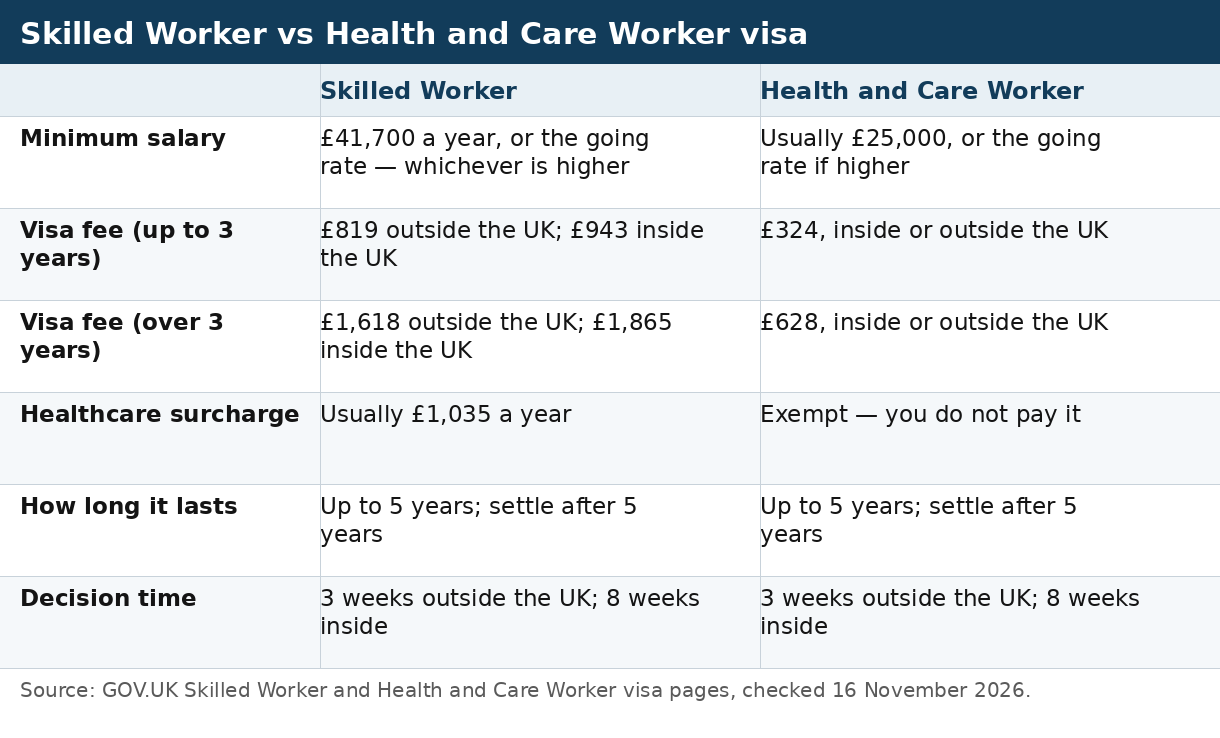
The two routes into Scotland, side by side — figures from GOV.UK, checked 16 November 2026.
Three worked examples show how the choice plays out in real life. A nurse starting at NHS Band 5, on £33,295 a year, fits the Health and Care route, because NHS roles are paid on the national pay scale instead of the £41,700 general minimum — the pay section below works through the exact bands. A software engineer offered £45,000 in Edinburgh fits the Skilled Worker route, because £45,000 clears the £41,700 minimum and the going rate for the role. And a care assistant offered £25,000 from outside the UK does not fit the Health and Care route for a new application, however good the job looks — that is the warning above, not a footnote.
If you are weighing Scotland against another country at the same time, the comparison is worth doing properly rather than by feeling. Canada runs a different system entirely — an employer assessment called an LMIA, and four separate routes instead of two — and our guide to jobs in Canada with visa sponsorship separates them the same way this guide separates the Scottish ones. The UK system is simpler to check, because one public register answers the only question that matters first: is this employer licensed? That check is the next section but one; first, the money.
How much do sponsorship jobs in Scotland pay?
Start with the number that decides most applications: £41,700 a year. That is the general minimum salary for the Skilled Worker visa, read on GOV.UK on 16 November 2026. But the number on its own misleads people, because the rule is "£41,700 or the going rate for your occupation, whichever is higher". Every occupation has its own going rate in a separate GOV.UK table. If the going rate for your job is £48,000, then £48,000 is your minimum, and a £45,000 offer does not qualify even though it clears £41,700. Always check both numbers for your exact job, never just the headline one.
There are two exceptions worth knowing. Healthcare and education jobs are paid at least the national pay scale rate instead of the general minimum, which is why a nurse on £33,295 can still qualify. And prison officers have their own minimum of £31,300. If your job is in health or education, your pay scale is your minimum — the £41,700 figure does not apply to you.
NHS Scotland pay is set by the Agenda for Change agreement, and the Scottish Government's own pay page — last updated 17 September 2026 — gives the 2025–26 rates. Band 2, where healthcare support workers, porters and catering assistants sit, starts at £25,731 a year (£13.34 an hour) and rises to £27,941 (£14.48 an hour). Band 5, where newly qualified nurses sit, starts at £33,295 a year (£17.26 an hour), rises to £35,576, and reaches £41,483 (£21.50 an hour) at its third point. The pay deal behind those figures is a two-year agreement: 4.4% from 1 April 2025 and 3.75% from 1 April 2026, guaranteed to stay at least one percentage point above inflation each year. The circular that sets it out is NHS Circular PCS(AFC)2025/5, dated 19 May 2025.
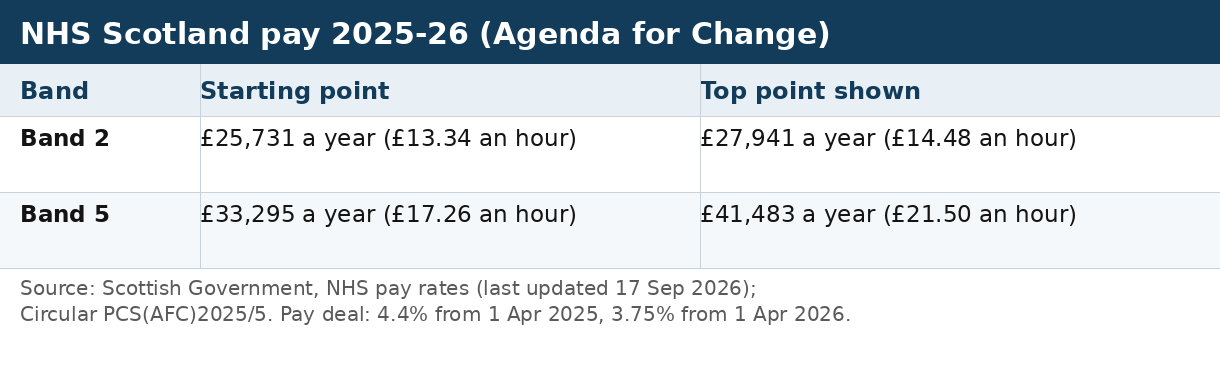
NHS Scotland pay, 2025–26 — Scottish Government figures, checked 16 November 2026.
Now do the maths that most guides skip, because it explains why the two routes exist. A Band 2 healthcare support worker on £25,731 earns far less than the £41,700 general minimum — yet the role can still sponsor, because healthcare roles use the pay scale rate instead. A Band 5 nurse at the top point, £41,483, still sits just under £41,700 — and still qualifies, for the same reason. The general minimum is a gate for the general route, not for the whole system. If someone tells you a £33,000 nursing job "cannot sponsor because it is under £41,700", they have read half the rule. Check the route, not just the number.
Outside the NHS, pay in Scotland follows the same pattern as the rest of the UK, with one difference that helps: the same salary stretches further in Scotland than in London, because rent and travel cost less. That does not make a low wage a good wage. A warehouse or hospitality role at £13 to £14 an hour is real work with real sponsorship only if the employer is licensed and the salary clears the route's minimum — and most entry-level roles do not clear it, which is why the in-demand section below is honest about which sectors actually sponsor. Judge every offer against the two numbers for your route, and against the cost of living where the job actually is.
The method we use for pay in this guide is the same one we use in our jobs in Leeds guide: every figure from the official scale or the live listing, dated, with the source named. Our UK sponsorship jobs overview covers the same salary rules for the UK as a whole, if you want the wider picture before you narrow down to Scotland.
Here is the method, step by step. First, take the exact organisation name from the job advert — not the brand name, not the trading name, the legal organisation name. Second, find that name in the register. Third, read two columns: Type & Rating, and Route. You want to see "Worker (A rating)" under Type & Rating and "Skilled Worker" under Route. An A rating means the sponsor is fully licensed. If the organisation is not in the register at all, it cannot sponsor you — no matter what the advert says, and no matter how senior the recruiter who contacted you sounds. Fourth, check the Town/City column to confirm you are looking at the Scottish branch, not a London office with the same company name.
The preview we read gives a feel for what a pass looks like. AaruvikA Limited in Edinburgh, ALT in Glasgow, and BOLTWHIZ LIMITED in Dunfermline all appear as "Worker (A rating)" on the "Skilled Worker" route. Those three are ordinary examples from the first rows of the preview, not recommendations — the point is that the check itself is quick and the answer is unambiguous. A-rated, Skilled Worker, Scottish town: that employer can sponsor. Anything else, and you need to ask questions before you apply.
Two things people get wrong about this check. First, being on the register does not mean the employer is hiring you, or hiring at all — it only means they are allowed to sponsor. You still have to win the job. Second, the register changes: licences are added and removed, and ratings change, so check on the day you apply, not from a screenshot someone sent you last year. Our UK sponsor licence list guide walks through the same check for the UK as a whole, and our companies providing sponsorship in the UK guide shows how to use the register alongside live job searching instead of treating it as a phone book.
If the employer is not on the register, do not waste an application on a sponsorship hope. Either the role is not sponsored and you would need an existing right to work, or the employer would have to get a licence first — a process that takes months and that you cannot do for them. Move on to the next employer. There are thousands of licensed sponsors; your shortlist should only ever contain licensed ones.
Which jobs are in demand in Scotland?
The honest answer starts with what the search results themselves say. The AI Overview on the live results page for this search names five sectors first: healthcare, engineering, IT, dentistry, and hospitality, all through Home Office-licensed employers. That matches what the listing pages show: care and health roles, tech roles, finance roles, and hospitality roles dominate the sponsored listings, with engineering close behind.
Healthcare is the biggest and most reliable door. NHS Scotland runs 22 Health Boards, and the Health and Care Worker route exists precisely for qualified doctors, nurses, health professionals and adult social care professionals with an eligible job at an approved employer. The NHS Scotland careers page describes a six-step route into these roles: check your eligibility and registration, take the English test, choose your route, interview and get an offer, receive your Certificate of Sponsorship and apply for the visa, then arrange flights and housing. One honest caution about that page: it was published in January 2023 and last updated in April 2024, and it still uses the old "shortage occupations" language. The visa rules have moved on since then, so use it for the NHS process and the Health Board structure, and use the GOV.UK pages for the current salary and eligibility rules.
Engineering and IT come next, and they are the best-paid sponsorship roles in Scotland. Software engineers, data people, and engineers in energy and infrastructure appear again and again in the sponsored listings, and the Skilled Worker route fits them naturally because their salaries clear the £41,700 minimum or the going rate. Dentistry is smaller but real — dental practices with a sponsor licence do hire from overseas, and the Health and Care route covers dentists. Hospitality sponsors too, but selectively: hotels and larger hospitality employers with licences hire chefs and managers, while small restaurants rarely hold a licence at all. If a small restaurant promises sponsorship, run the register check before you believe it.
Can you get sponsorship in Scotland? Yes — if three things are all true at once: the employer holds a licence, the job is on an eligible route, and the salary meets the minimum for that route. Any one of the three missing, and the answer is no for that particular job. That is also the answer to the question people actually type into Google most often — which job is easy to get sponsorship for. There is no easy job. The closest thing to easy is a job where all three are true and the employer hires from overseas regularly: NHS nursing, licensed engineering firms, and established tech employers. A role that meets all three is straightforward; a role that meets two is a waste of an application.
Does Scotland sponsor care workers? This is the question that needs the most careful answer in this guide, and the answer is: not the way the adverts suggest. As the routes section explains, care workers and senior care workers are not on the list for new Health and Care Worker applications from outside the UK — only for extensions and switches. Care homes in Scotland do still sponsor, but through the Skilled Worker route where the role and salary qualify, and you should read our care homes guide before you apply to any care home, because it shows how to verify the employer and the role instead of trusting the advert's wording.
NHS nursing deserves its own note, because it is the single most reliable sponsorship path in Scotland. The pattern is the same across the UK's health service: the employer is licensed, the role is eligible, the pay scale sets the salary, and the route is designed for overseas recruitment. Our nursing jobs guide for the Isle of Wight shows how NHS nursing hiring works in practice — the same employer-map and pay-band method, applied to a different part of the country. For Scotland, the employers are the 22 Health Boards, and the starting point is the NHS Scotland careers page, which you can read on the NHS Scotland Careers site.
Where in Scotland should I look — Edinburgh, Glasgow, Aberdeen or Dundee?
Scotland is not one job market. It is four cities with different employers, different pay, and different chances of sponsorship, plus smaller towns and rural areas where the NHS and the council are often the only licensed employers. Picking the right city first saves you from applying everywhere and hearing back from nowhere.
Edinburgh is the capital, and it hires in tech, finance, government, and the universities. The city has the biggest concentration of Skilled Worker roles in Scotland — software, data, financial services, and public-sector jobs — and the highest salaries, which matters because the £41,700 minimum is easier to clear here. It is also the most competitive: every overseas applicant looks at Edinburgh first. If your skill is tech or finance, start here, but do not stop here.
Glasgow is Scotland's largest city, and it hires more broadly: health, engineering, finance, and the public sector. The NHS presence is huge, the engineering base is real, and the city has more licensed employers across more sectors than anywhere else in Scotland. If you are a nurse, an engineer, or a public-sector worker, Glasgow gives you the most targets in one place.
Aberdeen hires in energy, engineering, and health. The energy sector — oil, gas, and now renewables — pays well and sponsors engineers, but it hires in cycles, and a downturn closes doors quickly. Health and the council are the steadier bets in Aberdeen. If your skill is energy engineering, Aberdeen is the first city to check; if it is not, the city still has NHS and council roles worth looking at.
Dundee is smaller, and its hiring is concentrated: life sciences, games and tech, health, and the universities. It has fewer sponsored roles than the other three cities, but also fewer applicants chasing them. A life-sciences or games-industry applicant can do well in Dundee precisely because the market is narrow and the employers know what they want.
Beyond the four cities, the public sector is the quiet sponsorship employer most people miss. Scotland's 32 local authorities and public bodies recruit through one shared portal, myjobscotland, which describes itself as Scotland's job website for the public and third sector. When we checked it on 16 November 2026, its category counts showed Education at 581 roles, Social Services, Housing and Childcare at 620, and Health Services at 102, with featured jobs closing between 16 and 25 November. The portal itself says nothing about sponsorship on its homepage — that is the honest limit of it — so use it to find public-sector roles, then run the register check on the employer before you apply. The same city-first logic applies to our Leeds city guide, which maps a city's employers the same way before it talks about applications at all.
How do I apply for a sponsorship job in Scotland, step by step?
Here is the order that works. Do not rearrange it — every step depends on the one before it, and skipping ahead is how people waste months.
Step one, pick your route. Skilled Worker or Health and Care Worker, using the comparison in this guide. If you are a nurse, doctor, or health professional, the Health and Care route is almost certainly yours. If you are in tech, engineering, or finance, it is almost certainly Skilled Worker. If you are a care worker outside the UK, re-read the care warning first — your route is not the one the adverts imply.
Step two, build a shortlist of licensed employers only. Use the GOV.UK register check from the section above, and keep only employers that show "Worker (A rating)" and "Skilled Worker" for a Scottish town. Ten real employers beat a hundred hopeful applications.
Step three, check the salary before you apply. Find the going rate for your occupation and compare it with the offer, or with the pay band in the advert. NHS roles use the pay scale — Band 2 from £25,731, Band 5 from £33,295 in 2025–26. If the salary does not meet your route's minimum, do not apply for sponsorship. Apply for the experience, or move on.
Step four, shape your CV for Scotland, not for home. A UK CV is short — usually two pages — with no photo, no date of birth, no marital status, and no identity number. It starts with your skills and your last two or three jobs, not your life story. Our UK CV format guide gives the exact section order, and our guide to writing a CV that gets replies shows how to turn duties into achievements with numbers. Run the finished CV through the same check our ATS score guide uses, because large Scottish employers — the NHS and the councils especially — shortlist against written criteria, and a CV that only lists duties gives them nothing to score.
Step five, apply on the employer's own careers page, never through a form that asks for a fee. If the role is on a jobs board, use the board to find it, then apply where the employer tells you to. Our guide to applying for jobs online covers the documents folder, the follow-up, and the mistakes that quietly kill applications.
Step six, interview and offer. Scottish public-sector interviews are often values-based and longer than a normal online form — the NHS six-step process names it directly: eligibility and registration, English test, choosing your route, interview and offer, Certificate of Sponsorship and then the visa, flights and housing. Prepare for the values questions, not just the technical ones.
Step seven, the Certificate of Sponsorship. Your employer issues it — you do not apply for it yourself, and you cannot buy one. Once you have it, you apply for the visa: up to three months before your start date, with a decision usually in three weeks from outside the UK. Keep £1,270 in savings held for 28 days to support yourself, and keep the proof ready — the costs section below explains the full bill.
A CV builder can take the formatting work off your hands once the content is right. You can build a Scotland-ready CV with the free PakkiNaukri CV builder, and if you want a human check on it first, our plans are Basic $2 and Premium $4 — see our pricing page for what each plan includes. The free builder is enough to get you started either way. And before the interview, read our job interview checklist — it covers the documents to carry and the questions to expect, so the interview itself is the only new thing on the day.
What does a sponsorship job in Scotland cost me?
Count the full bill before you start, because the headline fee is only part of it — and because the two routes cost very different amounts. All figures below are from the GOV.UK visa pages we read on 16 November 2026.
For the Skilled Worker visa, the application fee depends on where you apply from and how long the visa is for. From outside the UK, it is £819 for up to three years and £1,618 for more than three years, per person. From inside the UK — extending, switching or updating — it is £943 for up to three years and £1,865 for more than three years. Jobs on the immigration salary list are cheaper: £628 for up to three years and £1,235 for more than three years, the same inside or outside the UK. On top of the fee, the healthcare surcharge is usually £1,035 a year, and you need £1,270 in savings held for 28 days to support yourself. That savings figure is not a payment — it is money you must hold and show, and you keep it.
For the Health and Care Worker visa, the bill is much smaller. The fee is £324 for up to three years and £628 for more than three years, per person, the same inside or outside the UK. The healthcare surcharge does not apply at all — you and your family are exempt. You still need the £1,270 in savings held for 28 days.
Work it through for two real cases. A nurse coming on the Health and Care Worker visa for three years pays £324 for the visa, nothing for the surcharge, and shows £1,270 in savings she keeps. Her total out-of-pocket cost for the visa itself is £324. A software engineer coming on the Skilled Worker visa for three years from outside the UK pays £819 for the visa plus £1,035 a year for three years of surcharge — £3,105 — which is £3,924 in total, plus showing the same £1,270 in savings. Same country, same three years, twelve times the cost. The route is the difference, and it is worth choosing carefully.
Two warnings about money. First, nobody legitimate charges you for a job offer or a Certificate of Sponsorship. If anyone asks for payment for the CoS itself, or for "processing" before you have even been interviewed, walk away — the scams section below explains the pattern. Second, fees change. The figures above are current on the day we checked them, 16 November 2026, and GOV.UK updates them without warning. Check the GOV.UK cost pages again on the day you apply, and do not budget from a figure you read months ago.
How do I spot a fake Scotland sponsorship advert?
Most fake sponsorship adverts follow the same pattern, and once you know it, you can spot it in seconds. The advert promises sponsorship loudly and gives no way to verify it. No licence number, no employer name you can check, no link to a real careers page. The contact is a personal WhatsApp number or a free email address, not a company domain. The job is urgent, the pay is far above the market for the role, and the recruiter wants a fee — for processing, for the certificate, for the visa — before you have been interviewed. Every one of those is a red flag on its own. Two together, and the advert is not real.
The subtler trap is the real advert that cannot sponsor. Remember the top listing page we checked for this guide: its first role was a software job paying £90,000 to £120,000 a year, and the advert said plainly that it could not offer visa sponsorship. The listing page had tagged it under a sponsorship search anyway. That is not a scam — it is a search page doing a bad job of filtering — but the result for you is the same: an application that cannot lead to a visa. The defence is the same in both cases. Check the employer on the GOV.UK register before you apply, and check the salary against your route's minimum before you get excited about the pay.
Three rules will keep you safe. First, never pay for a job, a certificate, or a visa promise — the only fees in this process are the official ones on GOV.UK, paid to the government, after you have a job offer and a Certificate of Sponsorship. Second, never share passport scans, bank details, or original documents with a recruiter you found through a chat app — a real employer collects documents through its own secure system, after an offer. Third, if a role looks perfect and the employer is not on the register, believe the register. It is updated by the Home Office, and it is the only list that counts.
If you have already paid someone who promised you a Scottish sponsorship job, stop paying, keep every message and receipt, and report it. In the UK, Action Fraud takes reports of job fraud, and your own country's cybercrime or fraud reporting channel can take one too. Do not let embarrassment keep you from reporting — the people running these schemes count on silence.
What should I do next?
Do it this week, in this order, and the search stops feeling endless.
Today, pick your route and write it down: Skilled Worker or Health and Care Worker, with the minimum salary for your job next to it. Then open the GOV.UK register and build a shortlist of ten licensed Scottish employers in your field — Edinburgh tech and finance, Glasgow health and engineering, Aberdeen energy and health, or Dundee life sciences and games, whichever matches your skill. Check each one for the A rating and the Skilled Worker route, and cross off any employer that is not on the register.
Tomorrow, rebuild your CV to the UK format: two pages, no photo, no date of birth, achievements with numbers instead of a list of duties. Run it through the ATS check, and tailor the top half to the first employer on your shortlist — one tailored application beats ten identical ones.
By the end of the week, apply to five real roles at licensed employers, all through the employers' own careers pages, and save every application with its date. Then repeat the cycle next week with five more. Sponsorship job hunting is a numbers game played only with licensed employers — five careful applications a week, every week, will get you further than fifty hopeful ones in a day.
Your next step is the widest net with the filter already in your head. Go to the checked jobs on our jobs board and filter for UK roles — 58 were posted in the last seven days when we checked on 16 November 2026 — then run every employer you like through the register check before you apply. If you want the board to remember your search, create a free account so you can save roles and come back to them. The method in this guide does the rest: route, licence, salary, application. In that order, every time.
Frequently asked questions
Can I get sponsorship in Scotland?
Yes, if three things are all true at once: your employer holds a sponsor licence, your job is on an eligible route, and your salary meets the minimum for that route. Check the employer on the GOV.UK register of licensed sponsors first — if they are not on it, they cannot sponsor you.
Which jobs are in demand in Scotland?
Healthcare, engineering, IT, dentistry, and hospitality lead the sponsored listings, through Home Office-licensed employers. NHS nursing is the most reliable route, with 22 Health Boards hiring, followed by licensed engineering firms and established tech employers in Edinburgh and Glasgow.
Does Scotland sponsor care workers?
Not the way the adverts suggest. Care workers and senior care workers are not on the list for new Health and Care Worker visa applications from outside the UK — only for extensions and switches. Care homes can still sponsor through the Skilled Worker route where the role and salary qualify, so check the employer on the GOV.UK register before you apply.
Which job is easy to get sponsorship in the UK?
There is no easy job. The closest thing is a role where the employer is licensed, the job is on an eligible route, and the salary meets the minimum — NHS nursing, licensed engineering, and established tech employers are the most straightforward, because they hire from overseas regularly.
How do I check if a Scottish employer can sponsor me?
Open the GOV.UK Register of licensed sponsors: workers, download the CSV or use the online preview, and search for the organisation's exact name. You want to see "Worker (A rating)" and the "Skilled Worker" route for a Scottish town. If the employer is not in the register, it cannot sponsor you.
Put it to work on real, checked jobs.
Every job on PakkiNaukri is taken from a company’s own careers page and re-checked daily, and a free account scores each one against your CV. Start with today’s list.