
Jobs in Leeds: A Complete Guide
Published Nov 15, 2026
Jobs in Leeds: verified pay rates, the biggest employers, council and NHS routes, no-experience jobs and student work — checked 15 November 2026.

What is the fastest way to find a job in Leeds?
Leeds has jobs across health, care, retail, hospitality, warehousing, teaching and the council, and the fastest route is to match the job type to the right portal: council roles on the council jobs portal, NHS roles on NHS Jobs, university roles on university pages, and everything else on a jobs board. Tailor your CV to each advert before you apply.
That one paragraph is the whole method, and the rest of this guide is the detail that makes it work. Leeds is not a city with one job market. It is several, layered on top of each other: a big public sector, two universities, one of the largest NHS trusts in the country, a busy retail and hospitality centre, and warehouses and depots around the ring road. Each layer hires differently, pays differently, and is found in a different place. The mistake most job seekers make in Leeds is searching one board for everything and wondering why the results feel wrong. A care job, a council job and a warehouse job are barely the same activity, and they are certainly not found the same way.
Leeds had a population of 840,550 in 2025, with a median age of 36 (ONS, 2025). That young, large population is why the city supports so many entry-level and part-time roles alongside the professional ones, and why students compete with career changers for the same shifts. The city calls itself the largest city in the north on its own jobs pages, and whether or not you like the slogan, the scale is real: the council alone listed 174 live roles on its own portal when we checked on 15 November 2026.
PakkiNaukri is a free job board and CV builder for job seekers in Pakistan and for visa-sponsorship jobs in the UK, USA, Europe, the Gulf, Australia and New Zealand. We checked our own board for this guide on 15 November 2026: 8,865 checked jobs live, 626 of them in the UK, and none with Leeds in the job title or the company name. That last number deserves honesty rather than a shrug. Our board's search covers job titles and company names only, so a Leeds role is findable there only if its title or employer names the city. That is a real limitation, and it is exactly why this guide sends you to the council and NHS portals for Leeds-specific roles instead of pretending one board covers everything. Use our board for the wider UK search, and use the Leeds portals below for Leeds itself.
Before the detail, here is the map. Keep it open while you read.
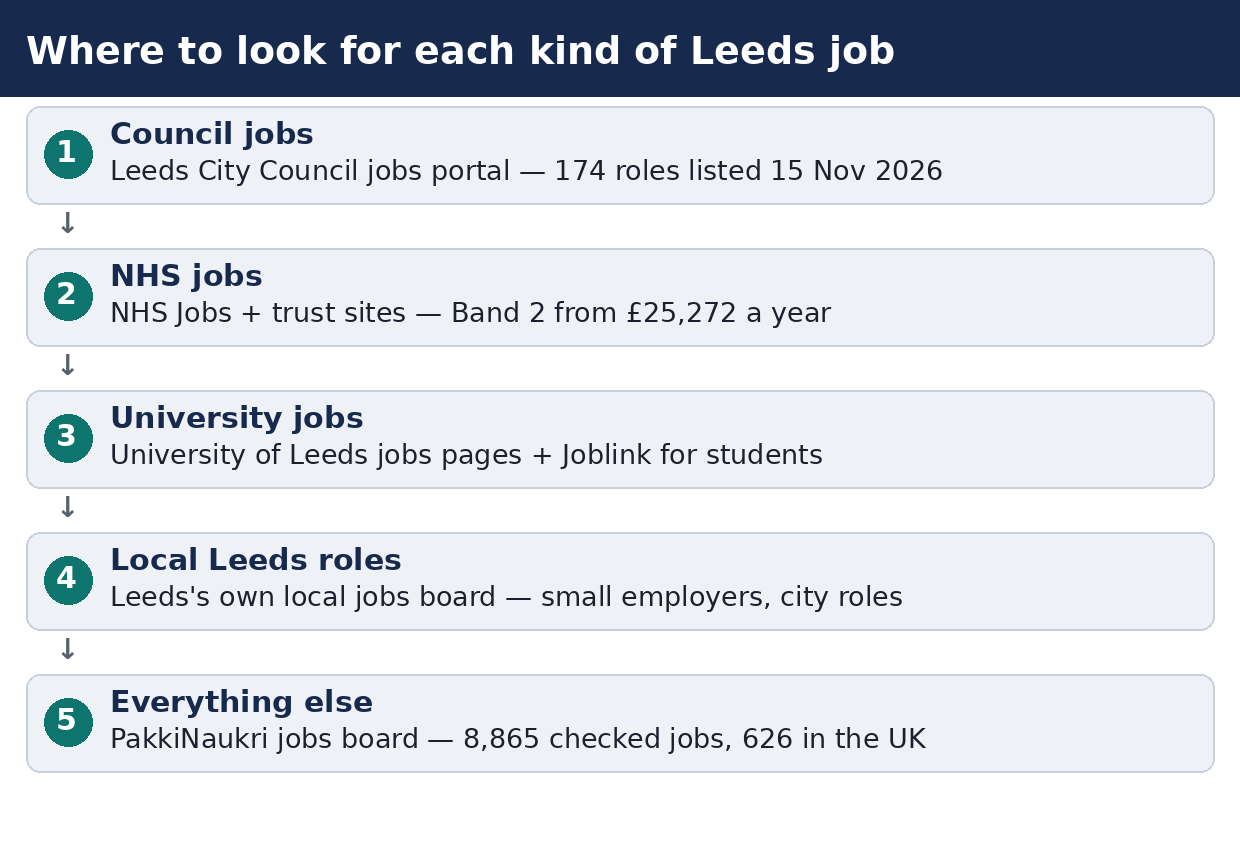
Where to look for each kind of Leeds job — match the job type to the right portal. Counts checked 15 November 2026.
If you are starting from zero — no CV yet, or a CV that has not been changed since your last job — fix that first. A two-page UK CV with no photo and no date of birth is the baseline every Leeds employer expects, and our UK CV format guide shows the exact section order and the personal-details rules. If your CV already exists, run it through the same check our guide to writing a CV that gets replies uses: achievements with numbers, not a list of duties. That single change matters more in Leeds than anywhere else, because the biggest employers here — the council and the NHS — shortlist against written criteria, and a CV that only lists duties gives them nothing to score.
How much do jobs in Leeds pay?
Start with the floor, because it decides whether a job is worth taking. The National Living Wage for workers aged 21 and over is £12.71 an hour from 1 April 2026 (GOV.UK). Workers aged 18 to 20 get £10.85 an hour, and under-18s and apprentices get £8.00. The previous 21-and-over rate was £12.21, so if you see that older figure on a job advert or a careers page, the page is out of date. The next rise, to £13.21, is already published for April 2027 — it is not in force yet, so do not budget on it, and do not let an employer quote it as today's rate either.
Most of the entry-level work in Leeds sits just above that floor. Warehouse roles listed in Leeds today pay £13.11 to £13.40 an hour. Care work usually pays £12.71 to £13.75 an hour, with some shifts reaching £15 or more for nights and weekends — but read the advert carefully, because the higher figure is often the enhanced rate for unsocial hours, not the basic rate. Retail assistants in Leeds commonly earn £11.60 to £13.00 an hour, with £12.71 the common rate for workers aged 18 and over. Teaching assistants on council listings earn £24,027 to £25,989 a year. An NHS Band 2 role — healthcare support worker, porter, catering assistant — pays £25,272 a year in 2026/27, a single pay point set by NHS Employers on 12 February 2026. None of these are guesses. They are the figures on the live listings and the official pay scales we checked on 13 and 15 November 2026, and the table below puts them in one place.
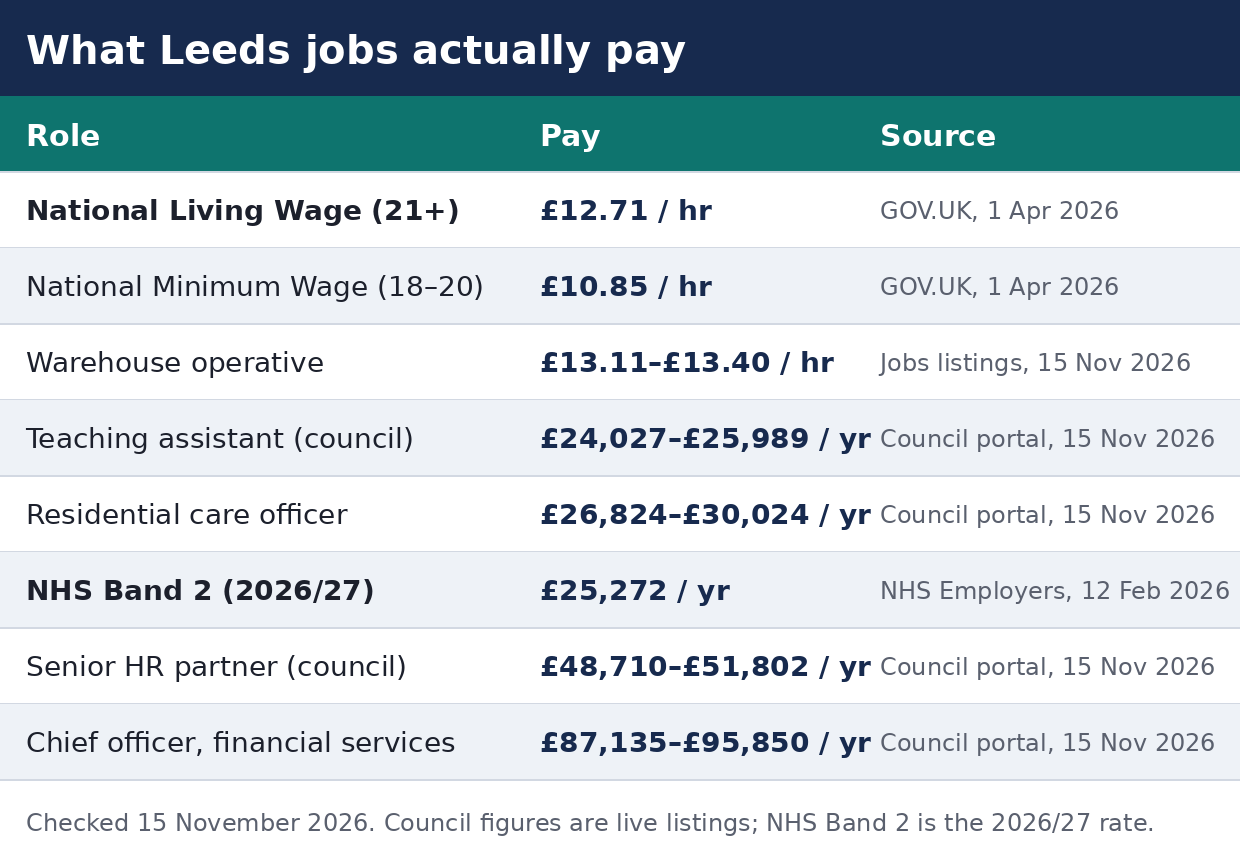
What Leeds jobs actually pay — every figure checked 15 November 2026.
Three things about that table are worth saying plainly. First, hourly and annual figures are not directly comparable without doing the maths. A £13.40-an-hour warehouse job on a 40-hour week is about £27,900 a year before tax, which is more than a £25,272 Band 2 role — but the warehouse job may be a temporary contract with no sick pay and no pension, while the Band 2 role comes with NHS pension, holiday and progression. Compare the whole package, not the headline number. Second, council pay bands are real bands, not starting points. A teaching assistant advertised at £24,027 to £25,989 will usually start at the bottom of the band, and the advert will say whether the figure is full-time equivalent or term-time only — a term-time-only salary looks smaller because it is paid for the weeks you actually work. Third, the top of the table is genuinely high. A chief officer in financial services at the council earns £87,135 to £95,850, and a senior HR partner earns £48,710 to £51,802. Those are senior, competitive roles with long applications. They are on the table so you can see the shape of the city's pay, not because most readers will apply for them this week.
One more honest point about pay in Leeds: the city is cheaper than London and Manchester for rent and travel, so a Leeds salary stretches further than the same number would down south. That does not make a low wage a good wage. It means you should judge a Leeds offer against Leeds costs — a room in a shared house, a bus pass, food — and not against a London figure you saw online. If the maths does not work after that honest comparison, keep looking. There are 174 council roles alone, and the city's hiring does not stop at the end of the month.
Who are the biggest employers in Leeds?
Leeds Teaching Hospitals NHS Trust is the giant. It employs 20,000 people, runs 7 hospitals across 5 sites, works with a budget of over £2.1 billion, and saw around 1.8 million patients last year (trust website, 15 November 2026). That scale is why healthcare dominates this guide: the trust is not one employer with one kind of job, it is a small city of porters, cleaners, caterers, healthcare support workers, nurses, therapists, administrators, IT staff and managers. If you want NHS work in Leeds, this trust is the first place to look, and the NHS section below explains exactly how.
Leeds City Council is the second anchor. It runs more than 500 services, from adult social care and children's services to highways, housing and planning, and it is the employer behind the 174 live roles we counted on its portal today. Council work suits people who want stable hours, a proper pension and a clear pay band. It also suits people without a degree: care officers, teaching assistants, apprentices and highways roles all appear regularly, and the council's own pages make a point of flexible working and generous holiday. The catch is the application itself, which is values-based and longer than a normal online form — the council section below walks through it step by step.
The two universities — the University of Leeds and Leeds Beckett University — are the third anchor, and they employ far more than lecturers. Between them they need administrators, technicians, librarians, cleaners, caterers, security staff, IT support and student-services officers. University jobs are worth watching because they are often term-time friendly and come with good holiday, and because both universities advertise on their own jobs pages rather than only on the big boards. Students should also know about Joblink, the University of Leeds student job service, which is listed on the first page of Google for this very search and yet is barely explained anywhere — the student section below explains it properly.
Then there is the private sector, and here Leeds surprises people who only know it as a shopping city. Financial and professional services are big — the city has a large banking, insurance and legal presence — and so is digital and tech, with employers across the centre and the South Bank. Retail and hospitality fill the centre, the stations and the shopping quarters. Logistics and warehousing sit around the ring road and the motorway junctions, which is why warehouse roles top the live listings today. And the rail industry matters more than most guides admit: Leeds is a major rail hub, and rail roles — from station staff to the shunter and depot jobs our shunter jobs guide covers — are a real route into steady, well-paid work for people who do not want an office.
The honest summary is this: if you want a career with progression, look at the trust, the council and the universities first. If you want work this week, look at warehouse, care, retail and hospitality. If you want the highest pay, look at senior professional and digital roles — but expect a longer, harder application. Nobody in Leeds has to pick just one of these forever. Plenty of people start on a warehouse night shift or a care rota and move into the trust or the council within a year, and the application skills are the same either way.
Which sectors are hiring in Leeds right now?
The short answer is: health and care first, then everything that keeps a city running. The longer answer needs the live counts, because a sector list without numbers is just a guess. Here is what the evidence actually shows on 15 November 2026.
Health and social care is the deepest pool. The trust's 20,000 staff turn over constantly — healthcare support workers, porters, cleaners, catering staff, administrators — and the council's adult social care and residential care roles appear in almost every batch of listings. Care is also the most honest entry point in the city: it asks for the right attitude and a clean background check rather than a degree, and it trains you on the job. Our nursing jobs guide for the Isle of Wight covers the same NHS application pattern — values, person specification, banded pay — and the pattern holds in Leeds too, even though the island is a different place. If you are considering care, read the NHS section below before you apply anywhere, because the Band 2 route is the one with the clearest pay and progression.
Teaching and education is the second pool, and it is bigger than most people think. The council's 174 live roles include teaching assistants, and schools and academies across the city hire support staff all year — not just teachers. A teaching assistant on a council listing earns £24,027 to £25,989 a year, and the work is term-time, which suits parents and students. The application is different from a normal job application: schools want to see safeguarding awareness and patience with children, not just a list of past jobs. Our Hounslow teaching jobs guide walks through the same teaching-assistant route — QTS, supply versus permanent, pay scales — and the Leeds version of that route works the same way, with the council portal as the starting point.
Retail, hospitality and customer service is the third pool, and it is the one that hires fastest. Shops, cafes, bars, hotels and call centres around the city centre take people on within days, not weeks, and the work is the natural first job for students and for anyone who needs income now. The pay is honest but modest — retail assistants commonly earn £11.60 to £13.00 an hour — and the real value is the speed and the flexibility. If you need a job this week, this is where to look first, and the no-experience section below tells you how to get in without a work history.
Warehouse and logistics is the fourth pool, and right now it is the loudest. The jobs module at the top of Google's results for this search is led by warehouse operative roles at £13.11 to £13.40 an hour, and the depots around the ring road and the motorways are hiring steadily. The warehouse section below explains the shifts, the physical reality and where the work actually is, because none of the ranking pages bothers to.
Professional services, digital and the council's own corporate roles are the fifth pool, and they are the slowest to hire but the best paid. Finance, legal, HR, data and IT roles appear in smaller numbers, stay open longer, and ask for a tailored CV and a proper application. If that is your target, the CV sections of this guide matter most — a generic CV will not get past the first screen, and our ATS-friendly CV guide shows how the structure changes by role.
A word of caution about counts. The big boards quote totals that do not reconcile — one aggregator's page says 3,025 jobs within 10 miles while its own search snippet says 3,032, and its "last 24 hours" filter counts more jobs than its headline total. Treat any single total as a rough guide, not a fact. The numbers in this guide are the ones we counted ourselves today, from the council portal and our own board, with the date attached. That is the only kind of count worth trusting.
How do I apply for a council job in Leeds?
Council jobs are worth a section of their own, because the process trips up good applicants who would sail through a normal application. Here is the whole route, step by step, as it works on 15 November 2026.
First, go to the Leeds City Council jobs portal. That is the front door. The jobs themselves live on a separate system called Webitrent, which the portal links to — so do not be surprised when the page changes style and asks you to register. Registering is free, and you will need an email address and a password you can remember, because every later step happens in that account.
Second, search properly. A blank search on the portal today returns 174 jobs, and that list includes schools and academies — some of them outside Leeds itself, in places like Keighley and Bradford. That is not a mistake, exactly, but it is unexplained on the site, so check the location on every listing before you apply. Filter by category if you know what you want: Adult Social Care, Children and Families, Highways and Transportation, Housing, Planning and Sustainable Development are all real categories on the portal. Read the salary format carefully, because it varies — some roles show an annual salary, some show an hourly rate, some show a pro-rata figure, and a few just say "£DOE", which means "depending on experience" and tells you nothing until you ask.
Third, understand what the council is actually scoring. Council applications are values-based. That means the form asks you to show, with examples, how you meet the council's values and the specific requirements of the role — not just to list your past jobs. A care officer application that says "I worked in care for two years" scores less than one that says "I supported three residents with dementia on a night rota, including one who became distressed, and I calmed the situation by…" — the second version gives the panel something to mark. The same rule applies to teaching assistants, highways roles and administrators. Write every answer as a short story with a result, and keep it specific to Leeds where you can: the estate you know, the community centre you volunteered at, the school your children attend.
Fourth, prepare your documents before you start the form. You will need a CV in a plain, readable format — two pages, standard headings, no graphics holding text — because the council's system has to parse it. If your CV has not been checked against an applicant tracking system, our guide to checking your CV's ATS score explains the five most common reasons systems reject a file, and why ATS rejects CVs shows the same failures with examples. Fix those before you upload, not after a rejection you never hear about.
Fifth, watch the deadlines. Council roles close on a stated date, and late applications are not accepted. The portal does not summarise deadlines in one place, so make your own list — role, closing date, reference number — and check it every morning while you are applying. And keep a copy of everything you submit. If you are shortlisted, the interview will be based on the same values and the same examples, and you will want your own words in front of you.
One last council fact that surprises people: the pay bands are public and the benefits are real. Flexible working, a proper pension, generous holiday and staff discounts are listed on the council's own recruitment pages, and they are part of the package, not a favour. A residential care officer at £26,824 to £30,024 with a council pension and generous holiday is a different proposition from the same hourly rate on an agency rota with none of those. Judge the whole offer.
How do I get an NHS job in Leeds?
The NHS is the biggest single employer in Leeds, and it is also the one with the most formal application process. Understanding the process is half the job.
NHS roles in Leeds are advertised on NHS Jobs and on the trust's own site. The trust — Leeds Teaching Hospitals, 20,000 staff, 7 hospitals across 5 sites — is the employer for most hospital roles, but community health, mental health and GP practice roles sit with other Leeds employers, so search by "Leeds" on NHS Jobs rather than by one trust name. Read the person specification before anything else. Every NHS advert has one, and it lists essential and desirable criteria in plain language. Your application is scored against those criteria, line by line, by people who do not know you. That is good news for an honest applicant: a well-evidenced application from a care assistant with two years of experience can beat a vague application from a graduate, because the scoring rewards evidence, not polish.
Band 2 is the usual starting point. Healthcare support workers, porters, catering assistants, domestic staff and ward clerks sit in Band 2, which pays £25,272 a year in 2026/27. The role is hands-on: helping patients wash and eat, moving equipment and people safely, keeping wards clean and fed, answering the phone and keeping records straight. It is physical, it involves shift work including nights and weekends, and it asks for patience more than qualifications. Most Band 2 adverts ask for basic literacy and numeracy and a caring attitude, and they train you in the rest. If you have looked after a family member, volunteered in a community setting, or worked in retail or hospitality, say so — with a specific example — because that is the evidence the panel scores.
Band 3 and above need more. Nursing associates, senior support workers and technical roles ask for qualifications or substantial experience, and the pay rises with the band. Do not apply for a Band 5 staff nurse role without a nursing qualification and registration — the system will filter you out, and the time is better spent on a Band 2 application you can actually win.
Three practical points. First, NHS applications are long, and the form will ask for your full employment history, gaps included. Fill the gaps honestly — a year out caring for a parent is not a weakness if you say what you did and what it taught you. Second, references matter, and the NHS checks them properly. Warn your referees before you apply, and make sure they are people who have actually seen your work. Third, if you are applying from outside the UK, check whether the role offers visa sponsorship before you spend hours on the form. The trust is a large sponsor, but not every role is eligible, and the eligibility rules change. Our visa sponsorship jobs guide explains how to check a role's sponsorship status, and the council and trust pages will say so on the advert itself.
Can I get a job in Leeds with no experience?
Yes, and Leeds is one of the better UK cities for it — but only if you aim at the right roles and present yourself the right way. "No experience" does not mean "no evidence". It means your evidence comes from life, not from a previous employer, and the trick is to write it down in a form a recruiter can use.
Warehouse work is the fastest door. Depots around Leeds take on operatives with no experience, train you on the job, and pay £13.11 to £13.40 an hour on the live listings today. The work is physical — lifting, walking, standing for a full shift — and the shifts include nights and weekends. If you can do that reliably, you can get hired. Say so plainly on your CV: "available for night shifts, full-time, starting immediately" is worth more than a paragraph about your career goals.
Care work is the second door, and it is the one with the clearest path upward. Care employers in Leeds hire for attitude and train for skill. A care assistant with no experience starts near the National Living Wage of £12.71 an hour, and the work leads — for people who stay — into senior care, team leading, and eventually nursing associate and nursing routes. The application should show the right qualities: patience, reliability, and a real example of looking after someone, even if that someone was a grandparent. Do not hide the lack of paid experience. Name it, then show the unpaid version.
Retail and hospitality is the third door. Shops, cafes, bars and hotels in the city centre hire constantly, and they care most about availability and attitude. Weekend and evening availability is a genuine advantage — say it in the first lines of your application, not buried at the end. A short, honest CV works here: your name, what hours you can work, any customer-facing experience at all (including school, volunteering, or helping in a family shop), and a phone number that you actually answer.
Apprenticeships are the fourth door, and the one most people overlook. The council lists apprentice roles — an apprentice HR role was live at £22,933 to £24,027 when we checked — and Leeds employers across sectors run apprenticeships that pay while you learn. The apprentice minimum wage is £8.00 an hour from 1 April 2026, but many Leeds apprenticeships pay well above that. If you are under 25 and unsure what to do, an apprenticeship is the closest thing to a free career.
Two more things. First, build a basic CV even if it feels empty. One page, your contact details, a two-line summary of what you can offer, any work at all (including unpaid), and your availability. Our CV builder tool gives you a clean template for exactly this, and it is free to start. Second, if you want the wider official picture — how to search, what to expect, where to get advice — the GOV.UK finding-a-job guide sets out the official routes in one place, and the National Careers Service (nationalcareers.service.gov.uk) offers free careers advice by phone and online. Both are free, and neither will try to sell you a course.
Where can students find part-time work in Leeds?
Leeds is home to two large universities — the University of Leeds and Leeds Beckett University — plus specialist colleges, and the part-time market is built around them. The best student work is found through student channels, not the general boards.
Joblink is the starting point for University of Leeds students. It is the university's own student job service, it lists part-time, casual and vacation work on and around campus, and it appears on the first page of Google for this very search — yet almost no guide explains what it is. It is, simply, the university's noticeboard for paid student work: campus jobs, local employers who want students, and one-off shifts. If you are a Leeds student, register there first. Leeds Beckett students should check their own university's careers service, which runs the same kind of listing.
Beyond the universities, the usual student employers are retail, hospitality, bars and cafes in the city centre, and the call centres and offices that take evening staff. Term-time work has one rule that matters more than any other: your degree comes first, and employers in Leeds know it. Say your available hours honestly — "weekday evenings and Saturdays, not during exams" — and you will get fewer shifts but keep them. Say you are available all hours and then cancel, and you will not be asked back.
Graduate routes deserve a sentence too. The professional services and digital employers here hire graduates directly, and the council and NHS run graduate and management trainee routes. If you are in your final year, start in the spring, not after graduation — the good schemes close early, and a final-year student with a tailored CV beats a graduate with a generic one every time. The recruitment jobs guide for Wolverhampton covers the same graduate and trainee routes in another UK city, and the pattern — trainee schemes, commission, sector choice — is the same in Leeds.
What is warehouse work in Leeds actually like?
Warehouse roles top the live listings for Leeds today, so they deserve a straight answer rather than a job description copied from an advert. A warehouse operative in Leeds picks, packs, sorts and moves goods in a depot or distribution centre. The work is physical from the first hour: you will be on your feet for a full shift, lifting boxes, walking between aisles, and working to a target. The pay on today's live listings is £13.11 to £13.40 an hour, which is above the National Living Wage of £12.71, and night shifts usually pay more. Most roles are full-time, many are temporary to start, and a good temporary worker is often offered a permanent contract — that is the normal route in, not a trick.
The shifts are the part people underestimate. Days, nights, weekends and rotating patterns are all normal, and the depot does not close because it is raining or because it is a bank holiday. If you take a night shift, your body needs a week to adjust, and your social life will bend around it. Go in knowing that. The depots themselves sit around the ring road and near the motorway junctions, not in the city centre, so check the bus route before you accept. A job that pays £13.40 an hour is not a good job if the bus takes ninety minutes each way and the last bus home leaves before your shift ends. Ask the recruiter about transport in the interview — it is a reasonable question, and a good employer will have a real answer.
What do you need to get in? Very little on paper: the right to work in the UK, basic English, and the ability to do physical work safely. Some depots ask for a forklift licence for specific roles, but they usually train you or hire you for non-forklift work first. What matters is reliability. Turn up on time, every shift, for the first month, and you will stand out — because the single biggest problem depots have is people who do not. Put that on your CV in plain words: "reliable, available for nights and weekends, full-time, starting immediately." It reads as basic, and it is exactly what the hiring manager is scanning for.
One warning, from the gap this guide found: the first page of the big boards for Leeds warehouse work is crowded with adverts for paid IT courses promising job placement. Those are not warehouse jobs. They are courses with a fee, and the "placement" is not a job offer. If an advert asks you to pay for training before you start work, close it. Real warehouse employers in Leeds pay you; they do not charge you.
How do I spot a fake Leeds job advert?
This is the section none of the ranking pages writes, and it is the one that saves people money. Leeds job seekers lose money every month to the same few tricks, and they are easy to spot once you know them.
Never pay to get a job. A real employer in Leeds — the council, the NHS, a warehouse, a shop — will never ask you to pay for training, a uniform, a background check, or a "registration fee" before you start. If money flows from you to them before your first payslip, it is not a job. The paid IT placement adverts that crowd the first page of the big boards work the same way: a fee first, a promise second, and no job at the end of it. A genuine advert tells you the employer, the location, the pay and the hours. A fake one tells you the dream and hides the details.
Check the employer exists. Search the company name with "Leeds" and "reviews" and see what comes back. A real Leeds employer has a website, an address, and people talking about working there. A fake one has a free email address, a mobile number, and nothing else. For council and NHS roles, apply through the official portals only — the council jobs portal and NHS Jobs — and never through a link in a text message or a social media comment.
For overseas applicants, there is one more check, and it matters more than any other. Before you apply for a Leeds role that promises visa sponsorship, check the employer against the register of licensed sponsors. Our UK sponsor licence list guide shows how to do that check in under a minute. A beautiful application sent to an employer who cannot sponsor you is a waste of your time, and a "sponsor" who asks you to pay for the certificate of sponsorship is breaking the rules — the sponsor pays that cost, not you. If you are unsure, our how sponsorship eligibility really works explains the route honestly, including which roles are genuinely eligible and which are not.
And a small practical habit: never send a CV with your full address, date of birth, bank details or copies of your passport in the first application. A name, a phone number, an email address and your work history are enough. The rest comes later, through the employer's proper process, once you have been shortlisted.
What should I do next?
Do not leave this page with a plan. Leave it with an application in progress. Pick the one route in this guide that matches the job you actually want, and start there today.
If you want a Leeds role with visa sponsorship, open the sponsored jobs in Leeds page and check which Leeds employers hold a sponsor licence before you apply anywhere. If you want the widest choice, open the checked jobs board and filter for UK roles — 626 were live when we checked today. If your CV needs work first, open the free CV builder, pick the template for your profession, and rebuild it using the method in this guide: achievements with numbers, two pages, standard headings, and an ATS check before you send it. It is free to start, and Premium is $4 — see what each plan includes — if you want the full template set. If you want a professional to rewrite it for you, our professional CV writers in London guide explains what writers charge, how to choose one, and the two-minute test that tells you whether paying is worth it.
Then send one application today. One, properly tailored, with the advert open beside you — not ten copied and pasted. Track it: role, employer, date sent, response. If ten applications bring no reply, change the CV or the targeting, not the city. Leeds has the jobs. The 174 council roles, the 20,000-strong trust, the warehouses at £13.40 an hour and the student shifts around the universities are all real, and they are all hiring now. The work is in matching yourself to the right portal, the right pay band and the right application — and that is exactly what this guide was for.
Frequently asked questions
What jobs are most in demand in Leeds?
Health and care roles lead — healthcare support workers, porters, care assistants and residential care officers — followed by warehouse operatives, retail and hospitality staff, teaching assistants and council roles. The council portal listed 174 live roles and the NHS trust employs 20,000 people, so those two employers alone cover most of the demand.
What is the highest paid job in Leeds?
The highest advertised pay in Leeds sits in senior management: a chief officer in financial services at the council earns £87,135 to £95,850 a year, and a senior HR partner earns £48,710 to £51,802. The roles in this guide's pay table run from £24,027 a year for a teaching assistant to £51,802 for a senior HR partner, with entry-level work at £12.71 to £15 an hour.
What is the best job website in Leeds?
It depends on the job type. Council roles are on the Leeds City Council jobs portal, NHS roles are on NHS Jobs, university roles are on the universities' own jobs pages, and student work is on Joblink. For the wider UK search, use a checked jobs board and filter by the UK, and always apply through the employer's own route where possible.
How do I get a job in Leeds?
Pick the sector, then use the right portal: council jobs on the council portal, NHS jobs on NHS Jobs, university jobs on university pages. Tailor your CV to each advert with achievements and numbers, apply before the closing date, and track every application. If you have no experience, start with warehouse, care, retail or hospitality roles, which hire fastest.
Can I get a job in Leeds with no experience?
Yes. Warehouse operatives, care assistants, retail assistants and hospitality staff are all hired without experience in Leeds, and apprenticeships pay while you learn. Warehouse roles pay £13.11 to £13.40 an hour on today's listings. Show reliability, full availability and any unpaid experience — such as caring for a family member — and build a one-page CV with your hours and contact details.
Put it to work on real, checked jobs.
Every job on PakkiNaukri is taken from a company’s own careers page and re-checked daily, and a free account scores each one against your CV. Start with today’s list.